Visit-olympia : Οργανώστε ένα μοναδικό ταξίδι στα μνημεία και αξιοθέατα της Ηλείας και δημιουργήστε τη δική σας επική εμπειρία. Kάντε κλικ εδώ
Visit-olympia : Οργανώστε ένα μοναδικό ταξίδι στα μνημεία και αξιοθέατα της Ηλείας και δημιουργήστε τη δική σας επική εμπειρία. Kάντε κλικ εδώ

Pyrgos Archaeological Museum · Collections
Discover the settlements, faith and connections of medieval Elis through the objects of the Byzantine collection.
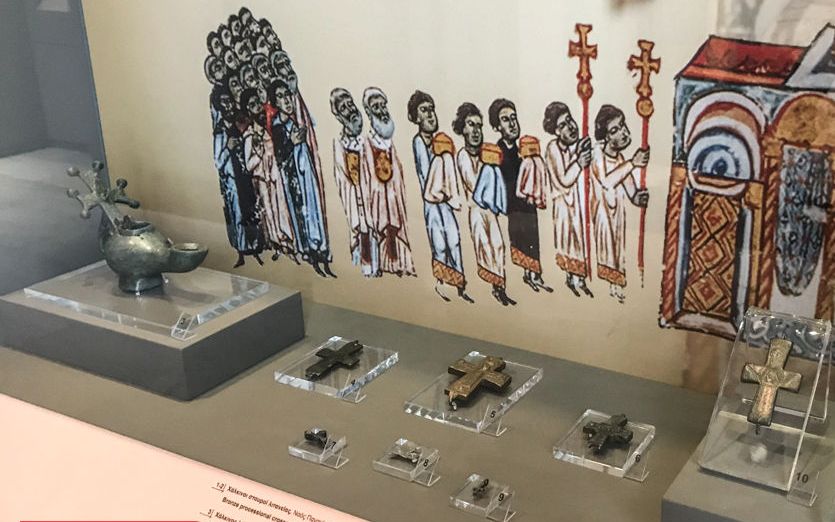
Constantine the Great’s refoundation of Byzantium as Constantinople, begun in AD 324, marked a turning point in the development of the Eastern Roman Empire and the gradual transformation of Roman culture. Its inhabitants called themselves Romans and regarded their state as the continuation of ancient Rome, with a divinely ordained mission. The closure of ancient sanctuaries, Germanic incursions and the destructive earthquakes of 522 and 551 severely affected Elis. Slavic settlement from the late 6th century formed part of the wider transformation of the region at the end of antiquity. During the Middle Byzantine period, from the 9th century to 1204, Elis was a predominantly rural part of the Peloponnese. After the Crusaders captured Constantinople in 1204, the region entered a new phase with the establishment of the Frankish Principality of Achaea, centred on Andravida and the imposing castle of Chlemoutsi. The exhibits introduce public and private life in the towns and villages of Byzantine Elis, its connections with other regions of the empire, the unifying role of Christianity and the movement of people and goods.
Constantine the Great’s refoundation of Byzantium as Constantinople, begun in AD 324, marked a turning point in the development of the Eastern Roman Empire and the gradual transformation of Roman culture. Its inhabitants called themselves Romans and regarded their state as the continuation of Rome, with a divinely ordained mission.Following the division of the Roman Empire in 395, Elis formed part of the province of Achaea within Eastern Illyricum. Roman institutions continued into the 6th and 7th centuries, but the closure of ancient sanctuaries, Germanic incursions and the earthquakes of 522 and 551 brought profound changes. Slavic settlement from the late 6th century was another element in this transition.During the Middle Byzantine period, from the 9th century to 1204, the region was largely rural. Arab raids along the Peloponnesian coast in the 9th century and Norman incursions in 1147 affected the wider peninsula. In the 12th century, the weakening of central authority and the growing independence of local elites disrupted imperial administration and defence, with possible consequences for Elis. Agriculture and livestock raising supported small rural communities.After the capture of Constantinople by the Crusaders in 1204, the Frankish Principality of Achaea emerged, with its capital at Andravida and a major stronghold at Chlemoutsi. In the early 15th century, Byzantine expansion brought Frankish rule to an end. Ottoman conquest followed in 1460.This section presents public and private life in Byzantine Elis through objects that reveal parallels with other regions of the empire. It also explores Christianity’s role in connecting culturally diverse communities and the region’s contacts and trade with other centres and populations.


Byzantine Period section, Pyrgos Archaeological Museum.


Aerial view of the surviving fortifications of the medieval town and harbour of Glarentza.


Plan of the Early Christian settlement at Olympia.

Inscribed grave slab from Elis. Byzantine period, 5th–7th century AD.
Photograph accompanying the exhibition section
Byzantine cities, foremost among them Constantinople, were centres of commerce, culture and religion. Initially retaining many Roman and Greek features, they changed in response to invasions, political instability and economic pressures. Rural communities became a mainstay of the imperial economy.
During the Middle Byzantine period, many cities contracted and strengthened their defences, developing narrow, winding streets and densely built neighbourhoods. Urban life increasingly centred on homes, local communities and religious institutions.
Despite these changes, cities remained important centres of trade, culture and religion. Their surviving monuments provide valuable evidence for Byzantine architecture, art and society.
In Late Antiquity, Elis and Phigaleia were major urban centres, both recorded in Hierokles’ Synekdemos. Olympia, often described as a rural settlement, also had workshops and processing facilities, suggesting a productive community with activities extending beyond agriculture.
7th–8th centuries: Raids and the reorganisation of the empire brought changes to settlement patterns. Some Early Christian towns contracted or were abandoned, while communities developed around smaller, more easily defended rural settlements. Agrapidochori illustrates this pattern in Elis.
Frankish rule after the Fourth Crusade: The establishment of Frankish states introduced new administrative structures and economic activities. Andravida became the political centre of the Principality of Achaea. Glarentza, with its harbour near ancient Kyllini, the port of Elis, became a major commercial centre linking the region to international trade. Gastouni developed as another settlement in the fertile plain.
Photograph accompanying the exhibition section
Byzantium was not ethnically homogeneous. It brought together peoples with different languages, customs and cultural traditions. Although Greek language and culture gradually became predominant, imperial identity rested on continuity with Rome and the universal Christian faith rather than a narrowly ethnic definition.
As part of this diverse empire, Elis was a place of contact between different communities. Archaeological evidence and broader historical developments offer several ways to explore these encounters:
Trade: Imported objects and coins offer evidence of commercial connections. Despite its rural character, Elis was not isolated. Coastal settlements and harbours connected it with suppliers elsewhere in the empire, including Constantinople and the eastern Mediterranean, and later with Italian cities. Ceramics, textiles, metals and coins help trace these exchanges.
Military presence: The empire drew its soldiers from many communities. Troops defending Elis or passing through it could bring local people into contact with soldiers from Anatolia, the Balkans and other regions. Military equipment with non-local features may provide evidence of such connections.
Practices and customs: Artistic traditions, burial practices and aspects of language may reflect contact with other communities. New techniques in pottery production or weaving, for example, can suggest the movement of craftspeople, although such interpretations require supporting evidence.
Population settlement: Archaeological evidence contributes to the study of Slavic settlement in Elis during the Early and Middle Byzantine periods. Its extent, the settlers’ way of life and the process of integration are less fully documented.

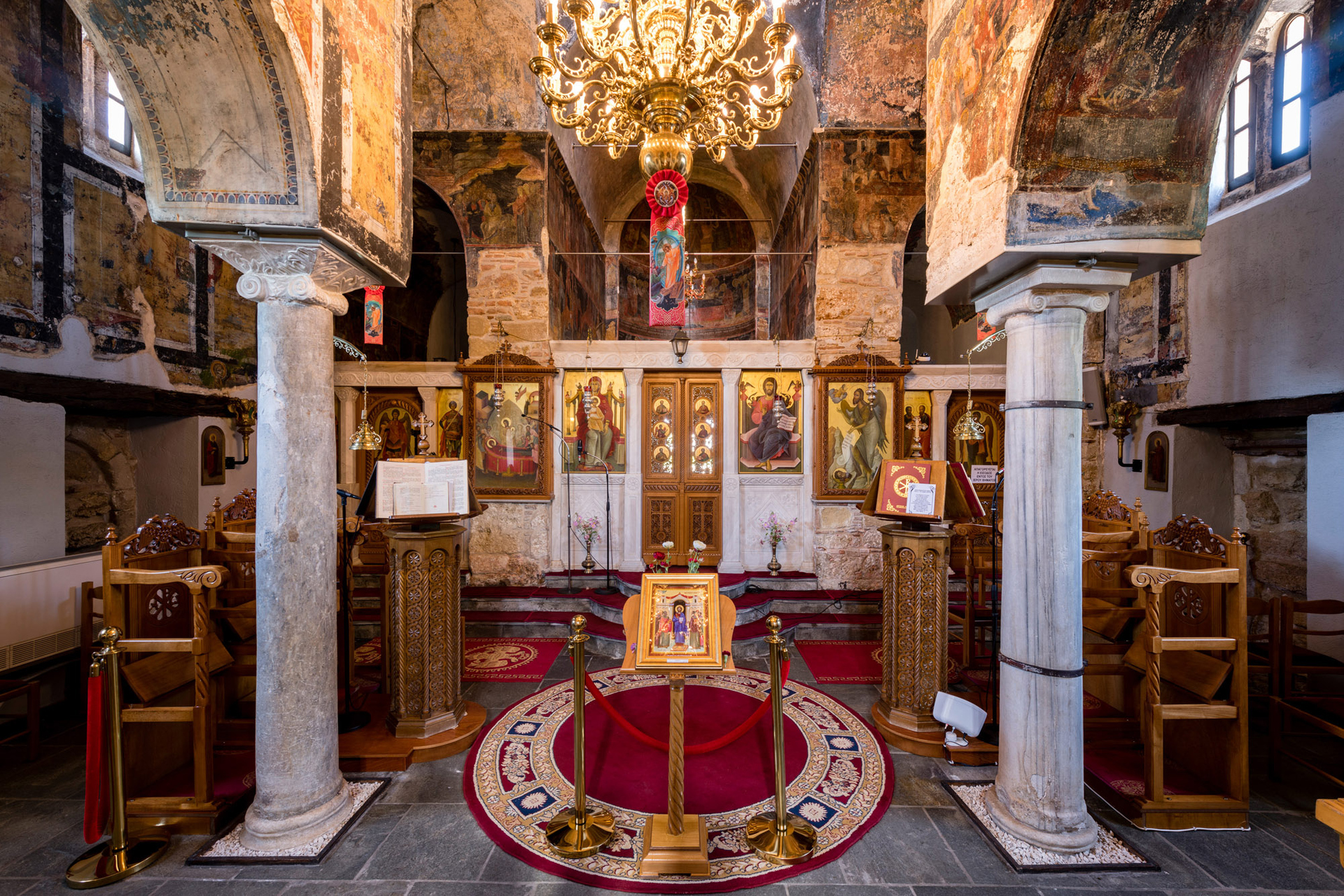
The Church of the Holy Trinity stands in the cemetery of Divri, in the Groustades or Apano Machalas neighbourhood. It is the oldest surviving monument of the village and the wider mountainous area of eastern Ilia. Its history extends from the 14th-century Palaiologan period to Ottoman times. The surviving wall paintings have two layers: the original Late Byzantine decoration of the 14th century and a later layer from the Post-Byzantine period.


The Church of the Holy Trinity stands in the cemetery of Divri, in the Groustades or Apano Machalas neighbourhood. It is the oldest surviving monument of the village and the wider mountainous area of eastern Ilia. Its history extends from the 14th-century Palaiologan period to Ottoman times. The surviving wall paintings have two layers: the original Late Byzantine decoration of the 14th century and a later layer from the Post-Byzantine period.


The religious history of the Peloponnese and Elis in Late Antiquity and the Middle Ages was shaped by the gradual transition from ancient cults to Christianity. This process extended over several centuries and varied with social, geographical and political conditions. Incoming populations brought further cultural and religious changes. Cremation, handmade pottery, partly sunken timber dwellings and slash-and-burn agriculture are among the practices associated with Slavic settlement, although individual finds cannot on their own establish ethnic identity.
After Constantine’s reign, Christianity became an increasingly important source of cohesion within the Roman Empire. Its spread was uneven, and older religious practices persisted for varying lengths of time, particularly in remote areas.
Elis had an episcopal see by the mid-4th century, under the ecclesiastical metropolis of Corinth. A geometric mosaic found in the south stoa of the ancient agora probably belonged to an Early Christian basilica of the second half of the 5th century. At Olympia, the building known as Pheidias’ workshop, west of the Altis, was later converted into an Early Christian basilica.
The bishopric of Olena appears in the historical record in the mid-8th century and came to exercise authority over an area broadly corresponding to modern Ilia. Its history continued through the Ottoman conquest of the western Peloponnese in 1460, and its ecclesiastical legacy survives today. Although written sources chiefly mention Olena as an episcopal centre, remains of a wall and gateway attest to a medieval settlement.
Frankish rule introduced Latin ecclesiastical institutions and encouraged the foundation of churches and monasteries with western artistic features. Prominent examples include Agia Sophia at Andravida, the church of the Monastery of Panagia Vlacherna near Kyllini and the church of the Monastery of Isova at Trypiti, in the municipality of Andritsaina–Krestena.
This thematic section presents Early Christian and Byzantine churches of Elis, objects used in their liturgy and items of personal devotion. Grave slabs and burial goods also reveal the funerary customs of the region’s Byzantine inhabitants.
Decorated with stylised palmettes, scrolls and leaves.
Elis. 4th–5th century AD.


Its body is leaf-shaped. The raised handle ends in an animal’s head.
Early Byzantine period, 5th–7th century AD.
The original Greek publication is available below. You can also open it in a new tab.
Komnenian period, 1081–1185.
One side depicts the youthful Christ and the other the emperor, wearing the loros, a ceremonial imperial garment, and holding an orb surmounted by a cross. Byzantine gold coinage played a leading role in medieval exchange. From the early solidus to the later hyperpyron, these coins enjoyed wide recognition and considerable prestige, although their weight and purity changed over time.

Justin II, Byzantine emperor from 565 to 578.
Struck at Constantinople, these coins were found buried in a house in the area of ancient Elis. Their owner concealed them after 578, presumably to protect them during a period of danger.
The concealment has been associated with the unrest accompanying Slavic incursions and settlement, during the final transformation of the ancient city of Elis.

