Visit-olympia : Οργανώστε ένα μοναδικό ταξίδι στα μνημεία και αξιοθέατα της Ηλείας και δημιουργήστε τη δική σας επική εμπειρία. Kάντε κλικ εδώ
Visit-olympia : Οργανώστε ένα μοναδικό ταξίδι στα μνημεία και αξιοθέατα της Ηλείας και δημιουργήστε τη δική σας επική εμπειρία. Kάντε κλικ εδώ

Pyrgos Archaeological Museum · Collections
Explore the Elean state, its cities and sanctuaries, and the connections that shaped life in ancient Elis.
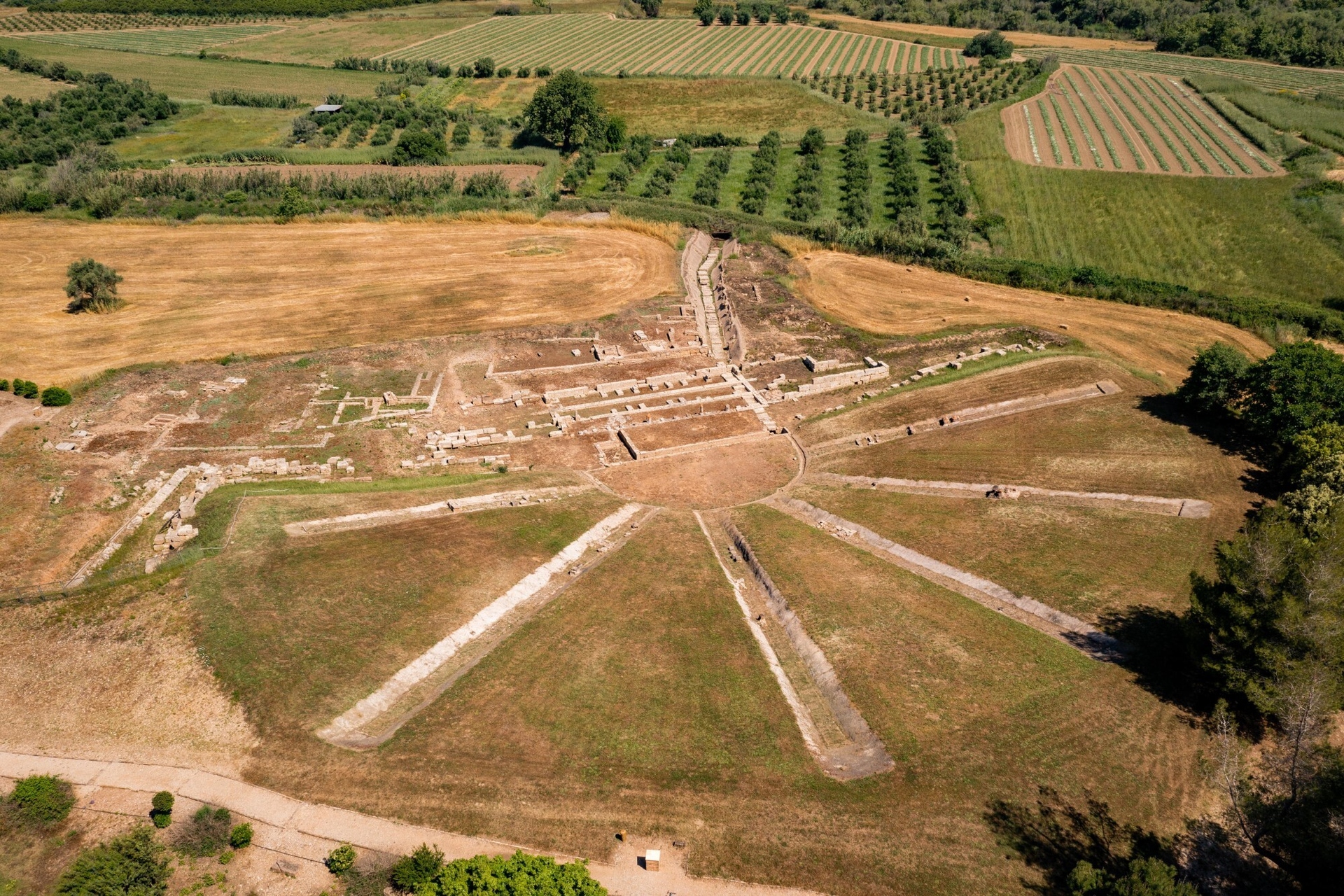
The permanent exhibition continues along the thematic axes shared by all its sections. Visitors discover the principal settlements, public and private life, religion and beliefs about the afterlife, and the commercial, economic and artistic contacts of the Eleans with the wider world.
The exhibits in this second section tell the story of the period in which the Eleans established their state, shaped its distinctive character and secured their place in the ancient Greek world.
The Olympic Games and the gradual emergence of Olympia as a sanctuary of Panhellenic importance played a decisive role in the political and social development of Elis.
Through this development, the Eleans strengthened their territorial security and the standing of their state throughout Greece, enjoying periods of peace and prosperity.
Their skill in organising the Olympic Games and administering the Panhellenic sanctuary of Olympia contributed to a long period of stability and economic growth.
Participation in the Peloponnesian War had painful consequences. After two Spartan invasions, the Eleans were compelled to surrender unconditionally in 399 BC. They lost territories including Akroreia and Triphylia and were forced to dismantle their harbours, fleet and the walls of their capital. Elis gradually became a smaller political state, while retaining the important privilege of organising the Olympic Games.
After the Battle of Leuctra in 371 BC, Elis recovered some territory and joined the Theban-led alliance, while fighting the Arcadians over Akroreia. From 343 BC it followed a pro-Macedonian policy. During the Hellenistic period it shifted alliances to preserve its autonomy and control of Olympia. Its subsequent alliance with the Aetolian League against the Achaean League led to its devastation by Philip V in 218 BC.
In 199 BC Elis aligned itself with Rome, and after 146 BC became part of the Roman dominion. Under the emperors it enjoyed stability and prosperity, largely through Olympia and generous Roman patronage.
In the 3rd century AD, Elis suffered raids by Goths and Herulians. The sanctuary of Olympia initially resisted the spread of Christianity but gradually declined. The ending of the Olympic Games, traditionally dated to AD 393 under Theodosius I, together with earthquakes and floods, contributed to the abandonment of Elis and Olympia.

Pyrgos Archaeological Museum: the northwest wing gallery, displaying stone objects, chiefly architectural elements from the historical period.

Female marble head inserted into a clothed upper torso made of limestone. From a monumental Hellenistic tomb excavated in 2009 on the southwest slope of the acropolis of Platiana. 4th–3rd centuries BC.

Bronze folding mirror (Μ02441). The cover bears a relief depicting the abduction of Ganymede by Zeus in the form of an eagle. From Makistos, Petropigada. Hellenistic period (323–146 BC).

Clay Elean lekythos (Π3627), decorated with embossed tongue-shaped motifs ending in leftward hooks. Used exclusively in funerary contexts. From Paliomylos, Palouki, Municipality of Ilida. Late 5th–first half of the 4th century BC.
Groups from almost every part of Greece settled in Elis. Early traditions associate the inhabitants of Elis and its plain with Achaeans, Arcadians and Aeolians, alongside Caucones, Leleges and Minyans from Thessaly, Aetolia, Attica, Asia Minor, Boeotia and Crete. Place names and mythical figures reflect these connections: Peneios, Larissos, Enipeus, Ephyra, Lapithos, Hippodameia, the Centaurs and Olympia.
The meeting of populations from different parts of Greece and the blending of traditions, customs and cults helped shape Elean identity and their sense of belonging to the Greek world.

Map of the regions of ancient Elis.
Photograph accompanying the exhibition section
According to ancient tradition, at the beginning of historical times in the 11th century BC, Dorian groups from Aetolia arrived in Elis under Oxylus. The earlier inhabitants and the newcomers came together to establish the state of Elis. The name Eleans, associated with King Eleios, replaced the name Epeians familiar from the Homeric poems.
The Eleans lived in numerous small settlements scattered across the countryside. Their land offered favourable conditions for prosperity and security.
The Elean state expanded and reached its greatest extent after the second synoecism of Elis in 471 BC. It then comprised four regions: Koile Elis, in the fertile Peneios valley to the north, named after the state’s capital; Triphylia, south of the Alfeios as far as the Neda; Pisa, on the northern bank of the Alfeios, containing the sanctuary of Olympian Zeus; and Akroreia, the eastern uplands bordering Arcadia. Citizenship was reserved for the inhabitants of Koile Elis. The other regions were dependent territories, whose communities repeatedly sought independence, often with intervention by Arcadians and Spartans.
Elis, the state capital and organiser of the ancient Olympic Games for more than a millennium, was a populous city at its height. The exhibition text estimates its population at 60,000.
Like other major ancient cities, Elis had a central agora with temples, shrines, altars, stoas and public buildings, alongside baths, athletic facilities and a theatre. Workshops, shops and houses were served by an organised network of streets, water supply and drains. These public and private facilities met the needs of residents as well as the many visitors and athletes who arrived every four years to prepare for the Olympic Games. Cemeteries generally lay outside the city limits.
The agricultural and pastoral character of the region nevertheless meant that most inhabitants preferred to live in small villages and hamlets close to their land.
Architectural fragments, road markers and ritual washing basins from many areas indicate organised settlements at sites across Elis, many of which remain unexplored.
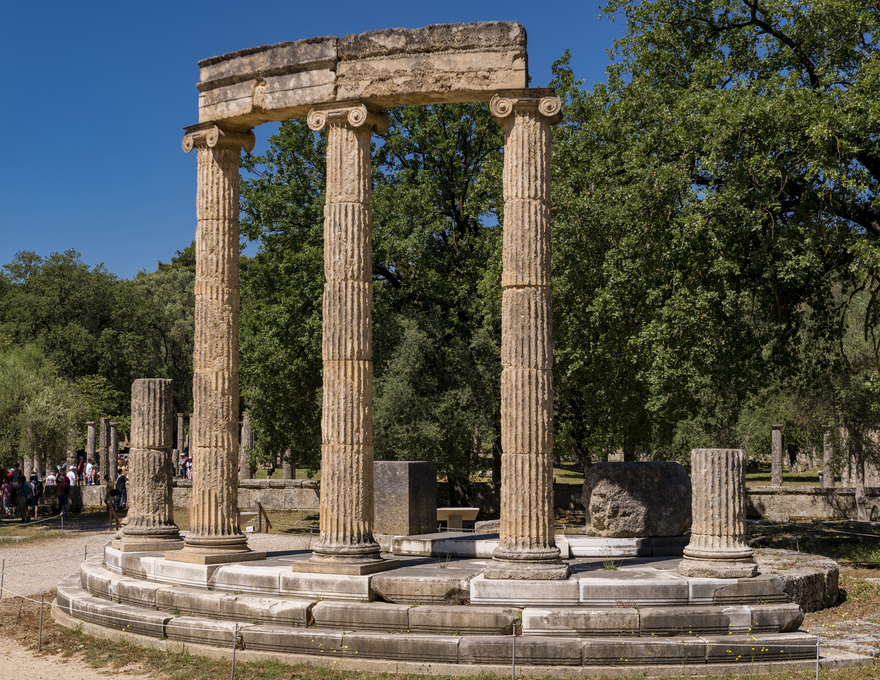
The Philippeion is one of the finest examples of ancient Greek architecture. It is the only circular building (tholos) located inside the Altis, the sacred precinct of Olympia. Situated west of the Temple of Hera, at the west end of the Altis and near the Prytaneion, it was dedicated to Zeus by Philip II of Macedon following his victory at Chaironeia in 338 BC. This dedication underscores the important political role the sanctuary played at that time. The construction of the Philippeion, along with the Metroon, represented one of the two major structures built within the Altis during the 4th century B.C. and the Hellenistic period.
The fertile, sacred land of Elis was dotted with sanctuaries, and worship formed an integral part of everyday life.
Alongside its smaller local sanctuaries, Elis contained Olympia, the great Panhellenic sanctuary. Its care and administration were central concerns of the Elean state, from the traditional date of the first recorded Olympic Games in 776 BC under King Iphitus to their ending in late antiquity, conventionally dated to AD 393.
After the Persian threat had receded, the magnificent Doric Temple of Zeus was built at Olympia by the Elean architect Libon. Beyond its religious role, it expressed power, prestige and cultural achievement. Precious dedications, including Pheidias’s gold-and-ivory statue of Zeus, impressed pilgrims and visitors and proclaimed the prominent position of Elis throughout Greece.
Other deities worshipped at Olympia included Hera, Eileithyia, goddess of childbirth, and Demeter Chamyne.
Pausanias describes numerous sanctuaries in Elis and its dependent towns. Only a few have been identified and excavated.
Many sacred places survive in ancient Triphylia. They served as regional religious centres with local importance and a significant role within their territories.
These include the sanctuary of Athena at Skillountia, small sanctuaries of Zeus at Makrisia and Bambes, and another sanctuary of an unidentified deity at Makrisia. Other important sites are Artemis’s sanctuary at Koumouthekra, Demeter’s sanctuary and a second small shrine on the acropolis of Lepreo, and Athena’s sanctuary at Prasidaki.
At Phigaleia, notable sanctuaries include Apollo Epikourios at Bassae, Athena and Zeus Soter, and the cave sanctuary of Demeter Melaina. At Alipheira, the remains of Athena’s temple and a sanctuary of Asklepios attest to the area’s religious and cultural importance.
In caves, on mountain summits and beside springs, these sanctuaries offered places where people encountered the divine.
This section presents finds illuminating religious life in Elis during the first millennium BC: sacred places, dedications, architecture, rituals and burial customs.

Olympia, the great Panhellenic sanctuary and birthplace of the Olympic Games, under Elean guardianship for most of antiquity.

Temple of Athena at Prasidaki. The Early Classical Doric temple was discovered in 1999–2000 at Elliniko or Leniko. Part of an Archaic temple was revealed during conservation work in 2002; additional work followed in 2003 and 2004. Built of soft limestone, it is a Doric peripteral temple with 6 × 13 columns, antae, a pronaos, cella and opisthodomos. Its three-step platform rests on a substantial euthynteria. The cella probably had a two-tiered interior colonnade; the base of the cult statue also survives. Its clay roof tiles had rich painted and moulded decoration. The temple was probably destroyed by an earthquake followed by fire in the 1st–2nd centuries AD. A dedication inscribed on the rim of a bronze bowl identifies Athena as the worshipped deity and indicates that the temple stood in the city’s agora. Nearby settlement and burial remains may belong to the small Triphylian town of Pyrgos, within the territory of Lepreo. The variety of finds and the monumental building demonstrate the importance of the cult.

Lepreo was an important site in both prehistoric and historical times, owing to its natural defences and favourable climate. In historical times it was the principal city of Triphylia. Its strategic position between Elis, Messenia and Arcadia led to repeated struggles for independence; it remained under Elean influence for much of its history. The fortified acropolis has walls and towers with a perimeter of 800 metres and a maximum surviving height of 4.5 metres. To the south stands the Doric peripteral Temple of Demeter and its altar, dating to the first half of the 4th century BC. Remains of the lower city survive to the south and southeast.
Bronze folding mirror (Μ02441). The cover bears a relief depicting the abduction of Ganymede by Zeus in the form of an eagle. From Makistos, Petropigada. Hellenistic period (323–146 BC).

Ivory handle in the form of a female figure. From Babylon, it illustrates the contacts of Elis with cultures and peoples of the East. Found at Kladeos. Hellenistic period.

Clay transport amphora (Π03261), recovered from the submerged harbour of ancient Pheia at modern Agios Andreas, Katakolo. Such amphorae were used in overseas and transit trade. Shells and salt deposits reflect centuries in the sea. Pheia and Kyllini were vital ports for transporting goods and people to and from Elis throughout antiquity.

Globular clay aryballos (Π02488). Aryballoi held perfumed oil and were a characteristic product of Corinth, a major centre of production and export in the 7th century BC. Found at Alipheira. Circa 650–600 BC, Archaic period.

Small glass amphora, a perfume container (Δ00139), made in the eastern Mediterranean tradition. From the Temple of Artemis at Koumouthekra. Late 6th–5th century BC.

Photograph accompanying the exhibition section
Elis: a world in miniature
Discover how a society rooted in agriculture and animal husbandry connected with the wider world. Assyrian and Babylonian objects and characteristic transport amphorae from the ancient harbour of Pheia reveal the region’s trading relationships and influences from other cultures.
This section places the history of Elis within wider networks, offering a fuller picture of the economy and culture of the Elean state.
Despite its rural character, Elis had cosmopolitan connections and extensive trade. Coins from Greek cities and imported objects, including Corinthian aryballoi and Attic black-figure lekythoi, reveal cultural exchange and external influences.
Different populations lived and interacted in Elis, contributing to its artistic and commercial production.
The section also explores contacts with Elean colonies in Epirus and Italy, and the region’s intellectual influence throughout Greece. The Olympic Games played an important part in the development of a shared Greek identity.
During the Geometric period, in the late 9th and early 8th centuries BC, Eleans established colonies in Kassopaia, including Pandosia, Bouchetion, Elateia and Batiai. Traditions connect these movements with the departure of inhabitants following the arrival of Aetolian-Dorian groups. Figurines resembling examples from Olympia provide evidence of these links.
In the early 6th century BC, further groups of Eleans settled at Epidamnos and Apollonia, superseding the earlier colonies.
Ancient accounts also mention Elean participation in the colonisation of Italy and Sicily. Pindar records an Elean presence at Syracuse associated with the Iamids.
The lioness stands with its head turned left and its right forepaw resting on a ram’s head. It served as a 4th-century BC funerary monument, expressing the courage of the deceased and symbolically protecting the grave from violation.
From the Archaic period onwards, lions were among the most common animal-shaped grave markers. They acted as guardians and symbols of courage, notably on collective graves of those killed in battle.

Explore the subsections

The Sacred Way linking Elis and Olympia.
Elis was responsible for preparing and organising the ancient Olympic Games. Athletes wishing to compete had to report there at least forty days before the Games. As the Elean capital, the city administered the Panhellenic sanctuary of Zeus at Olympia.
The Hellanodikai first examined the athletes’ eligibility. Competitors then learned the rules and principles of fair competition and trained in the city’s athletic facilities. This process selected those who were adequately prepared and excluded athletes whose performance or eligibility did not meet the requirements.
Those who passed the demanding preparation and assessments earned the right to compete at Olympia and joined the sacred procession travelling to the sanctuary.
Literary sources place Elis 300 stadia, approximately 58 km, from the sanctuary of Zeus at Olympia along the lowland Sacred Way.
Before the Olympic festival, the great sacred procession assembled at Elis and travelled on foot to Olympia along the Elean Sacred Way.
At its head were the Hellanodikai, priests and Elean officials, the theoroi or official representatives of Greek cities, and athletes with their trainers. Riders and charioteers with their horses and chariots, residents of Elis and the surrounding countryside, and numerous visitors and pilgrims joined them, bringing rich offerings and animals for sacrifice to Zeus.
At the spring of Piera, the Hellanodikai sacrificed a pig as part of a purification rite. The procession then continued to Letrinoi, near modern Pyrgos, where its members spent the night. Around midday on the following day they reached Olympia, marking the opening of another Olympic festival.
The same lowland Sacred Way was used for the Heraia, the festival in honour of Hera at Olympia organised by the Elean “Sixteen Women”, based in Elis.
The Panathenaic procession in Athens, immortalised on the Parthenon frieze, offers a comparison in magnificence and significance.
Sea routes carried a substantial share of people and goods in antiquity. Obsidian transported from Melos to Franchthi Cave in the Argolid provides early archaeological evidence of Mediterranean navigation, dating to the 9th millennium BC. The development of Elis as an urban centre and Olympia as a religious centre owed much to their proximity to the sea and to the enduring ports of Kyllini and Pheia.
The hundreds, and later thousands, of pilgrims brought precious dedications, other goods, animals, merchandise and provisions. Maritime passenger and cargo traffic grew with advances in shipbuilding and navigation and the increasing fame of the Olympic Games.
Kyllini
For much of antiquity, Kyllini served as the port of Elis. Pausanias describes its sheltered bay and piers, which protected ships from south-westerly winds. These natural advantages explain its continued use from antiquity to the present. A settlement developed beside the harbour by Homeric times or earlier. Its name may be associated with Arcadians who came from Mount Kyllini in Corinthia, now known as Ziria.
Strabo (64 BC–AD 24) and Pausanias describe Kyllini as a small settlement 120 stadia, approximately 23 km, from Elis. They mention an ivory statue of Asklepios by Kolotes, a pupil of Pheidias, a sanctuary of Aphrodite and a cult image of Hermes in the form of an erect phallus. After the Crusades, the port regained prominence. Geoffrey II of Villehardouin founded Clarentia, also known as Glarentza, on the remains of the ancient harbour, frequently reusing its building material. It became the port of Andravida, capital of the medieval Principality of Achaea.
Pheia
Surviving remains suggest that Pheia was extensive but sparsely populated. In Classical times it occupied Cape Ichthys, extending north towards modern Skafidia, where the ancient river Iardanos enters the Ionian Sea. Its acropolis stood on the hill now occupied by the remains of Pontikokastro, a Byzantine fortress built over the ancient acropolis and later held by the Franks.

According to literary sources, the lowland Sacred Way from Elis to Olympia measured 300 stadia, approximately 58 kilometres. The sacred procession walked this route before the Olympic Games. Historical map by Barbié du Bocage, from Voyage du jeune Anacharsis en Grèce, 1787.

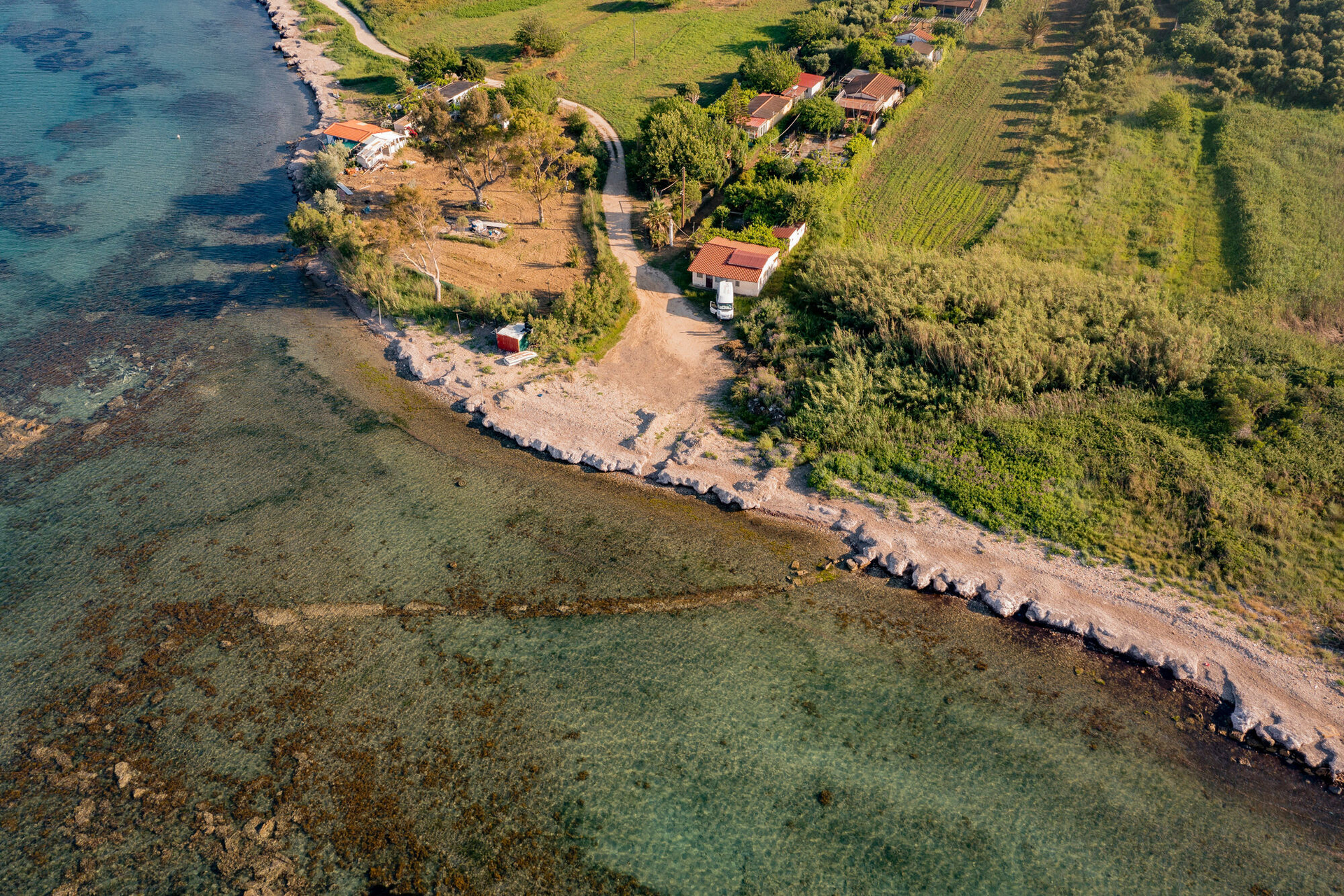
Remains of the ancient harbour installations at Kyllini
Pottery transport amphora (Π03261), recovered from the submerged harbour of ancient Pheia at modern Agios Andreas, Katakolo. Such amphorae carried goods in overseas trade. Shells and salt deposits reflect their long immersion in the sea. Pheia and Kyllini were vital ports for the movement of people and goods to and from Elis throughout antiquity.
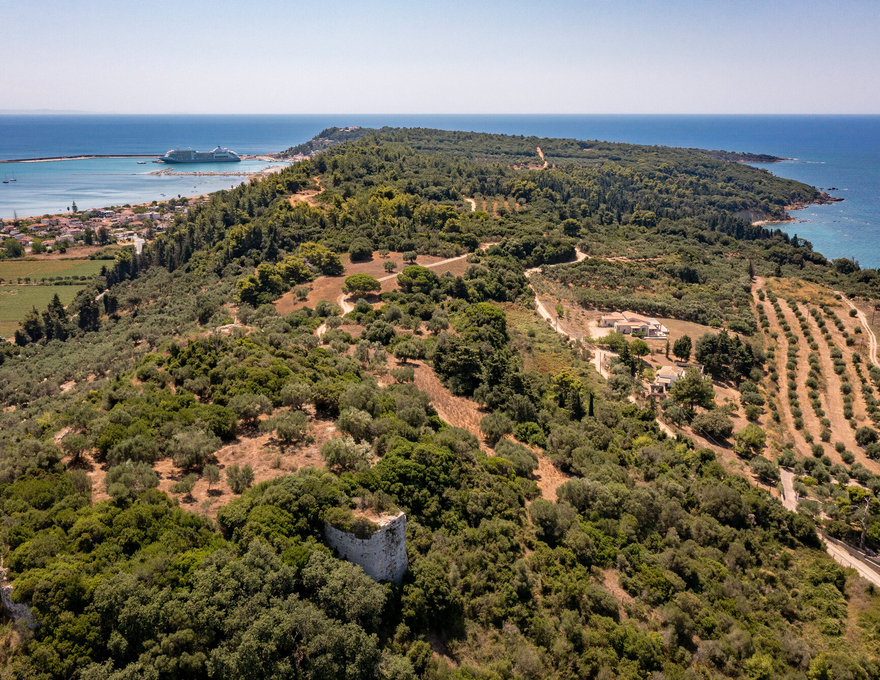
Cape Ichthys: the ancient harbour of Pheia and the modern port of Katakolo

The inhabitants of ancient Makistos dedicated the Temple of Athena to their shared goddess and a deity revered throughout Greece.
The temple stands near modern Skillountia, south of the Alfeios. Only its three-stepped platform and a few scattered architectural members survive. Built in the Doric order from local friable shell limestone, it used the same kind of stone as monuments in Olympia’s Altis. Architectural, historical and epigraphic evidence dates it to 525–460 BC. Its pediments depicted the Gigantomachy to the east and the Amazonomachy to the west. Excavations began in 1880 under E. Kastorchis and P. Kavvadias. Work in 1978–1981 uncovered a 4th-century BC bronze inscription with a decree of the Triphylian League referring to Athena and citizens of Makistos, helping identify the temple.
Finds displayed in Pyrgos Archaeological Museum include this bronze inscription and pedimental sculptures, among them bearded marble heads and a nude helmeted warrior.
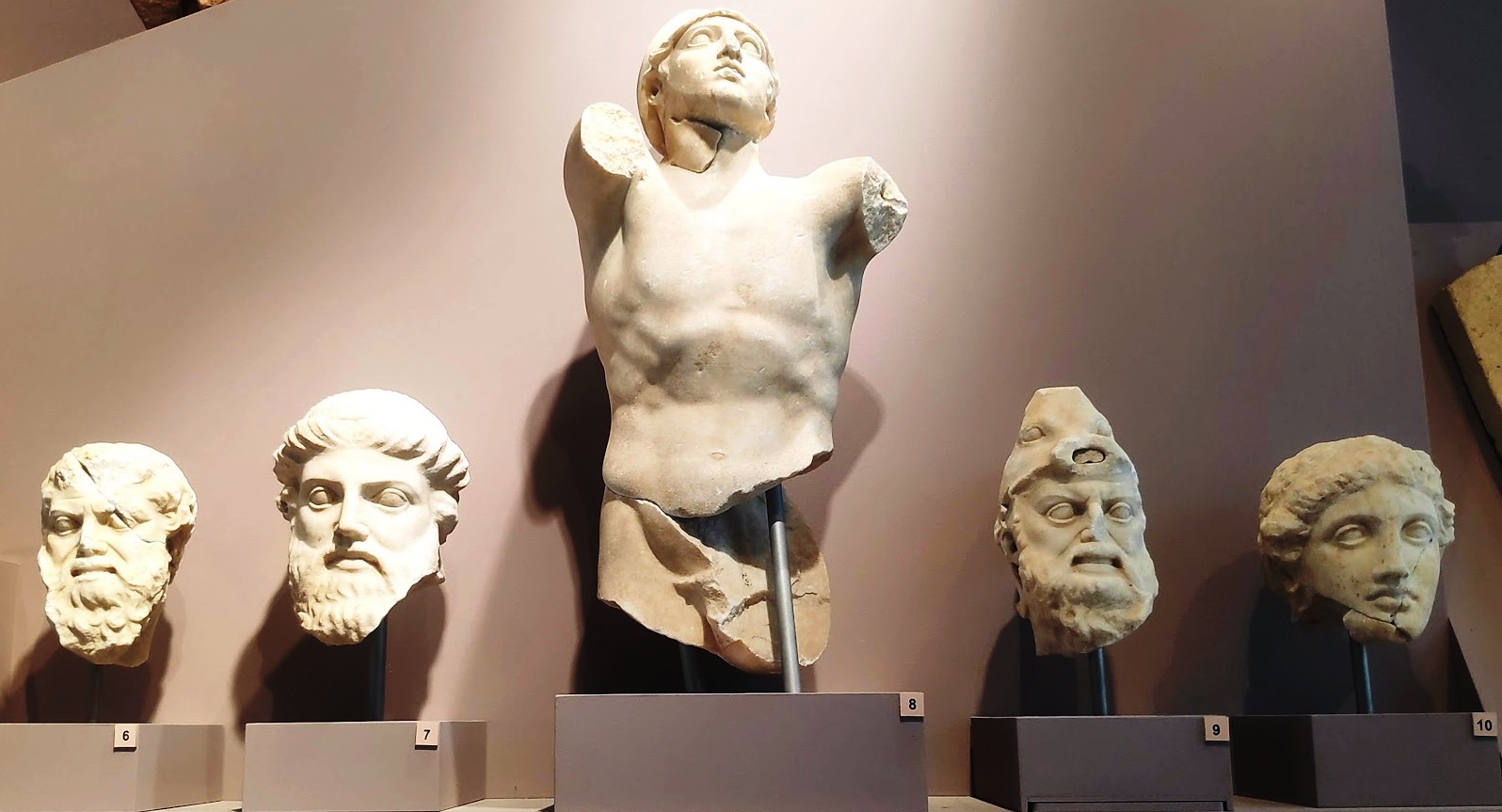
Temple of Athena at Mazi, Skillountia: sculptural decoration
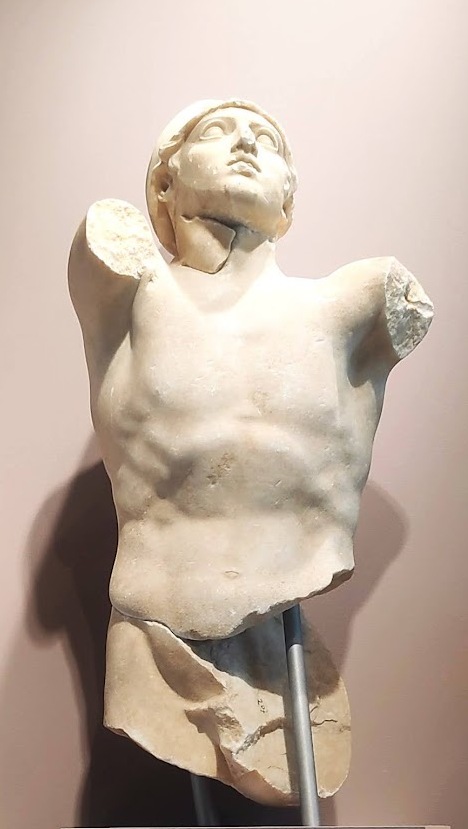
Marble nude helmeted warrior (Λ2090), reassembled from three fragments and preserved to the upper thighs. Only the beginnings of the arms survive; the left hip and part of the pubic area are missing. The figure wears a Corinthian helmet with a concave neck guard. A hole survives on the left shoulder blade, with traces of two others at the broken left arm. Its movement combines lightness and force. From the west pediment of Athena’s temple at Skillountia, depicting the Amazonomachy.
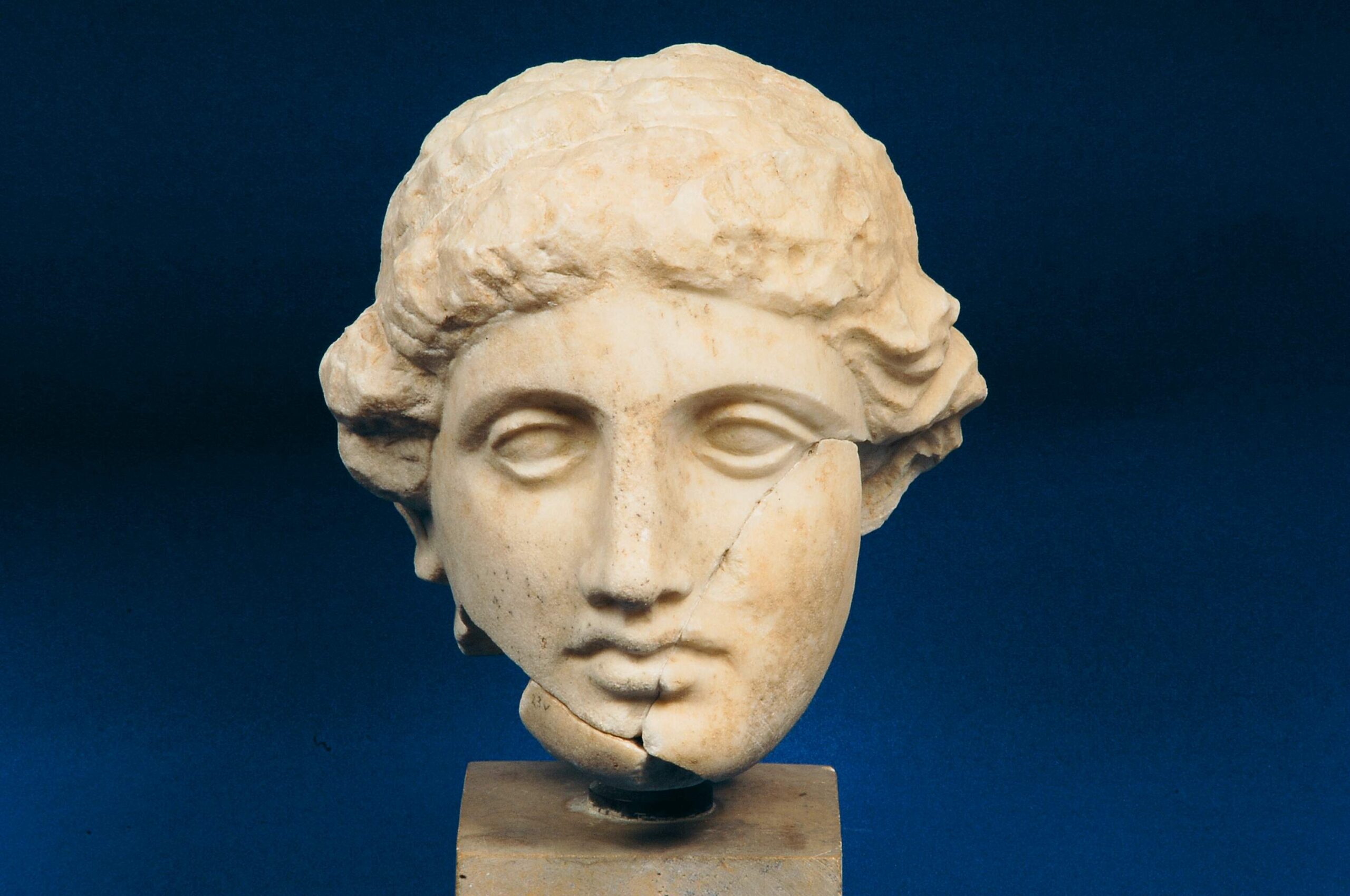
Marble female head (Λ02087), reassembled from three fragments. The ear area behind the left cheek is broken. The face is oval, with almond-shaped eyes, sharply defined eyelids and a slightly open mouth. Centrally parted hair frames the face in loose waves and partly covers the right ear. A broken surface beside the parting indicates a missing attachment. From a statue in the east pediment of Athena’s temple at Mazi, Skillountia, depicting the Gigantomachy. First half of the 4th century BC.
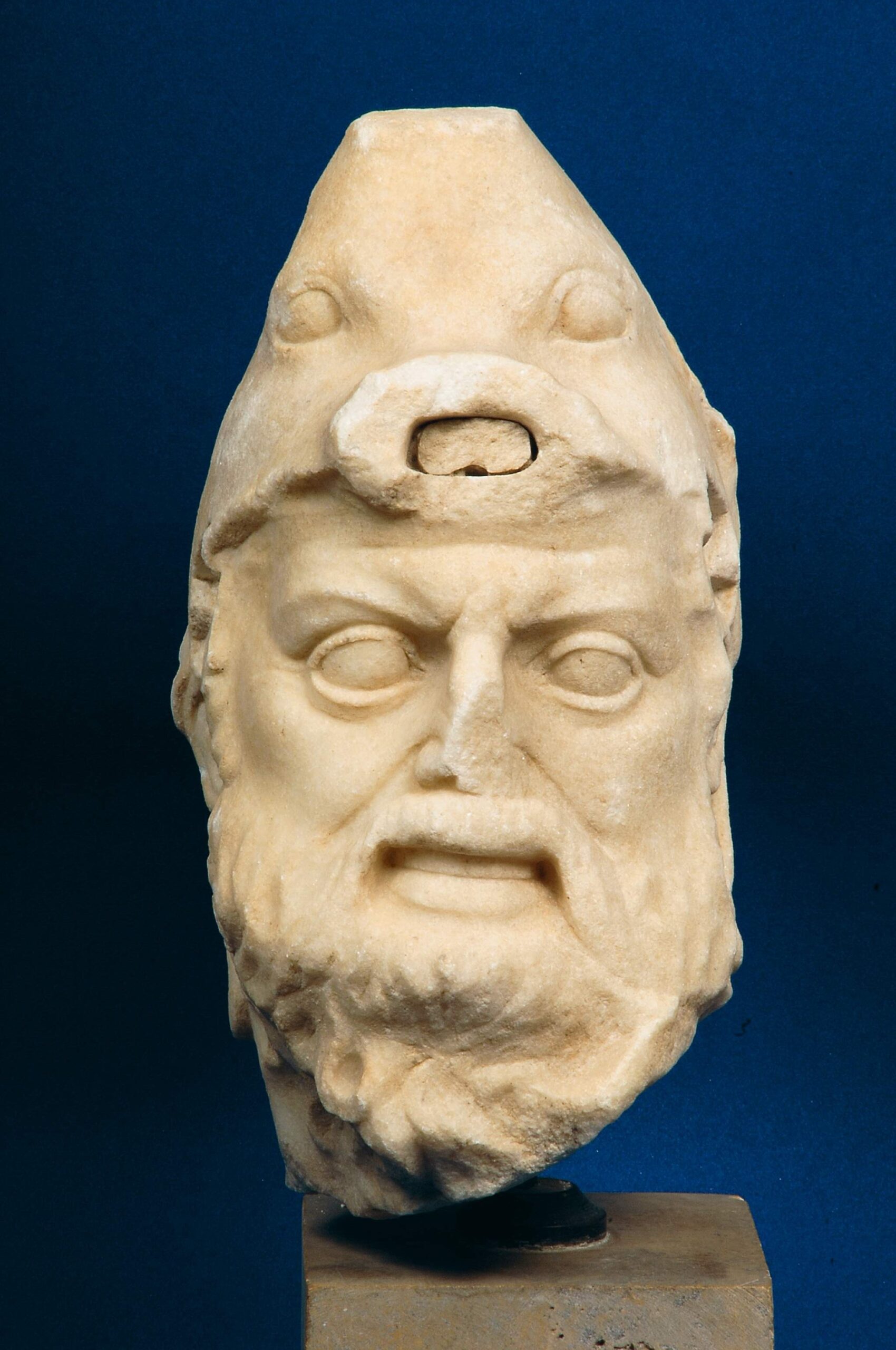
Marble head of a bearded helmeted figure (Λ02089), almost complete. The upper helmet takes the form of an animal’s head; its separately fitted crest, muzzle and ears are damaged. The cheekpieces were separate attachments. The figure has a frowning expression, wrinkles on the forehead and around the eyes, an aquiline nose, a partly open mouth and a beard of short wavy curls. From the east pediment of Athena’s temple at Mazi, Skillountia, depicting the Gigantomachy. First half of the 4th century BC.

Clay black-figure plaque depicting the prothesis, or laying out of the body. The deceased lies on a bed surrounded by family members, some pulling their hair in mourning. Archaic period, second half of the 6th century BC. Source: https://art.thewalters.org/detail/19887/black-figure-pinax-plaque/
The ancient Greeks, including the Eleans, observed elaborate customs and ceremonies for the dead, some with echoes in modern practice. Rooted in prehistoric traditions, these rites honoured the deceased and consoled their relatives. They followed several stages:
After the funerary meal, Hermes Psychopompos was believed to guide souls to the banks of the Acheron, separating the living from the underworld. Charon ferried them across to Hades. Relatives placed a coin, Charon’s obol, in the deceased’s mouth to pay the fare. Hades was both the ruler of the underworld and the name of the dark realm of the dead. Elis had a sanctuary of Hades that opened once a year.
These customs reflected cultural, religious and social traditions, emphasising remembrance and honour for the dead.
Personal possessions and specially made grave offerings were placed in the tomb, including:
Toys for children, such as dolls, carts and animals.
Vessels, including oinochoai, amphorae and cups, containing food and drink for the journey to Hades.
Jewellery, such as bracelets, earrings and necklaces, belonging to the deceased or made for burial.
Figurines depicting people, animals or deities.
Weapons, deposited with men as symbols of social status.
