Visit-olympia : Οργανώστε ένα μοναδικό ταξίδι στα μνημεία και αξιοθέατα της Ηλείας και δημιουργήστε τη δική σας επική εμπειρία. Kάντε κλικ εδώ
Visit-olympia : Οργανώστε ένα μοναδικό ταξίδι στα μνημεία και αξιοθέατα της Ηλείας και δημιουργήστε τη δική σας επική εμπειρία. Kάντε κλικ εδώ

Pyrgos Archaeological Museum · Collections
Discover early life in Elis through settlements, beliefs, exchange and the objects of the prehistoric collection.
The permanent exhibition begins with objects associated with the earliest inhabitants of Elis.
The prehistoric collection offers a window onto the ancient world of Elis and the wider Peloponnese. Its exhibits reveal the history and culture of the region’s early inhabitants, from the Neolithic period to the end of the Mycenaean civilisation.
The introductory section presents palaeontological finds from the plain of Elis and the area of Olympia.
The favourable environment of Elis attracted people as early as the Middle Palaeolithic period (120,000–35,000 BC). Tools from numerous archaeological sites provide evidence of hunting and, in later prehistoric periods, farming and animal husbandry.
The position of Elis near maritime routes linking northern Europe and the Italian peninsula made it an important point of contact for the exchange of ideas and goods.
However, the scarcity of extensive settlement remains limits our understanding of how prehistoric populations settled in the region.
During the Late Bronze Age, or Mycenaean period (1600–1200 BC), the region developed considerably. In the Homeric tradition, Elis was one of the four principal towns of the region that participated in the Trojan War. Its inhabitants, known as the Epeians, were led by Polyxenus, a descendant of King Augeas, famous for his dispute with Heracles over the cleaning of his stables.



The Middle Palaeolithic period saw the development of Homo sapiens alongside other human populations, including the Neanderthals.
Settlements and social organisation
This period was important for human development. Collective responses to challenges helped lay the foundations for later societies. Evidence of habitation and tools demonstrates human adaptability and innovation in demanding conditions.
Living in groups was essential for survival. Shared places of habitation offered protection, access to resources and opportunities to divide tasks.
Early social structures were based on cooperation and interdependence, marking the development of organised community life.
In Elis, the scarcity of extensive settlement remains deprives us of valuable information about the organisation of prehistoric communities.
Nevertheless, surviving habitation remains document occupation from the Neolithic to the Submycenaean period. Olympia is a particularly important centre, with the earliest traces of habitation dating to the Final Neolithic period (4300–3100 BC).
Other prehistoric settlements at Lepreo and Strefi provide evidence of community life. Burial assemblages excavated throughout Elis also shed light on everyday life.
Stone tools illustrate technological development and people’s ability to adapt to their surroundings. They were used for hunting, processing food and constructing shelters.
Prehistoric religious practices in Elis reflect people’s close relationship with nature and concerns such as fertility, protection and justice. Religious beliefs were closely connected with the communities’ understanding of the world and their social identity.
Our knowledge of religious beliefs in prehistoric Elis is limited and rests on archaeological evidence associated with deities and sacred places in the region.
Ancient traditions locate early sacred places at the southern foot of Kronios Hill in Olympia. Cults associated with Kronos, Rhea and Gaia reflect the relationship between religion, natural forces and fertility. Eileithyia, Themis and the Idaean Heracles were also among the deities worshipped there.
Religion played a central role in the activities of prehistoric communities.
Cult practices and religious symbols reveal influences from Minoan Crete, a major civilisation of the contemporary Aegean. Shared sacred symbols, such as double axes and horns of consecration, suggest connections between religious traditions.
The roots of many later Greek deities can be traced to Mycenaean times. The important Mycenaean cemeteries at Agia Triada, Kladeos, Mageiras and Dafni offer a fuller picture of burial customs and funerary rites, including mourning, the funeral procession, burial, the funerary meal, animal sacrifice and offerings to the dead.
Cult objects and symbols
Similar figurines, seals and vessels suggest the circulation of religious beliefs and objects among Aegean societies. Shared objects and symbols underline the role of religion in connecting communities.
Open-air worship
The absence of identifiable purpose-built temples suggests that ceremonies could take place outdoors, on hilltops, in caves and at other natural places regarded as sacred. This reflects the close connection between religion and the natural environment.
Religion and social activities
Religion extended beyond ritual into art, political life and everyday activities. Festivals and ceremonies probably provided opportunities for social cohesion and exchange.


The eastern Mediterranean was home to a complex network of communication. Trade supported economic development and the spread of cultural and technological innovations, contributing to the growth of the region’s major civilisations.
The limited availability of certain raw materials in mainland Greece, including Elis, encouraged the formation of wider trading networks. These enabled communities to obtain essential resources and supported technological, artistic and cultural exchanges.
Obsidian from Melos was important for making tools and weapons. Its import began in the Mesolithic period and continued into the Middle Bronze Age, providing evidence of active exchange and distribution networks.
Copper and tin, the main components of bronze, were scarce in mainland Greece. They were probably imported through networks linking Greece with metal-producing regions, including Cyprus and Anatolia.
Gold, silver and semi-precious stones, such as carnelian and rock crystal, were used chiefly for decorative or ceremonial purposes.
Silver and lead from Lavrion began to be mined systematically towards the end of the Middle Bronze Age, indicating advances in mining technology.
Small quantities of gold may have come from alluvial deposits in Elis that were rapidly exhausted, suggesting the temporary exploitation of local resources.
Bone stylus (Δ00512), elongated, with a flattened body tapering to an edge. Both sides are decorated with small dotted circles. A Mycenaean grave offering interpreted as indicating the occupation of a scribe. Late Helladic III (14th–12th century BC).
A rare find from the Mycenaean cemetery at Agia Triada, in the municipality of Ilida, in upland Elis.

Clay Kefti (Vapheio-type) cup (Π00075), reassembled from numerous fragments and restored. A raised ring divides the conical body into a cylindrical lower part and an upper part that flares outwards. It has a vertical strap handle and is decorated with closely spaced, parallel vertical wavy lines. A characteristic drinking vessel of early Mycenaean pottery. From Kleidi, Kato Samiko. Mycenaean period, Late Helladic I (second half of the 16th century BC).
Large clay rhyton (Π00070), reassembled and restored. The pointed conical body has a wide mouth, a slightly concave neck and a raised strap handle. Parallel bands cover its entire height. This ritual vessel was used as a grave offering. From the tumulus at Kleidi, Kato Samiko. Mycenaean period, Late Helladic III A2 (second half of the 14th century BC).
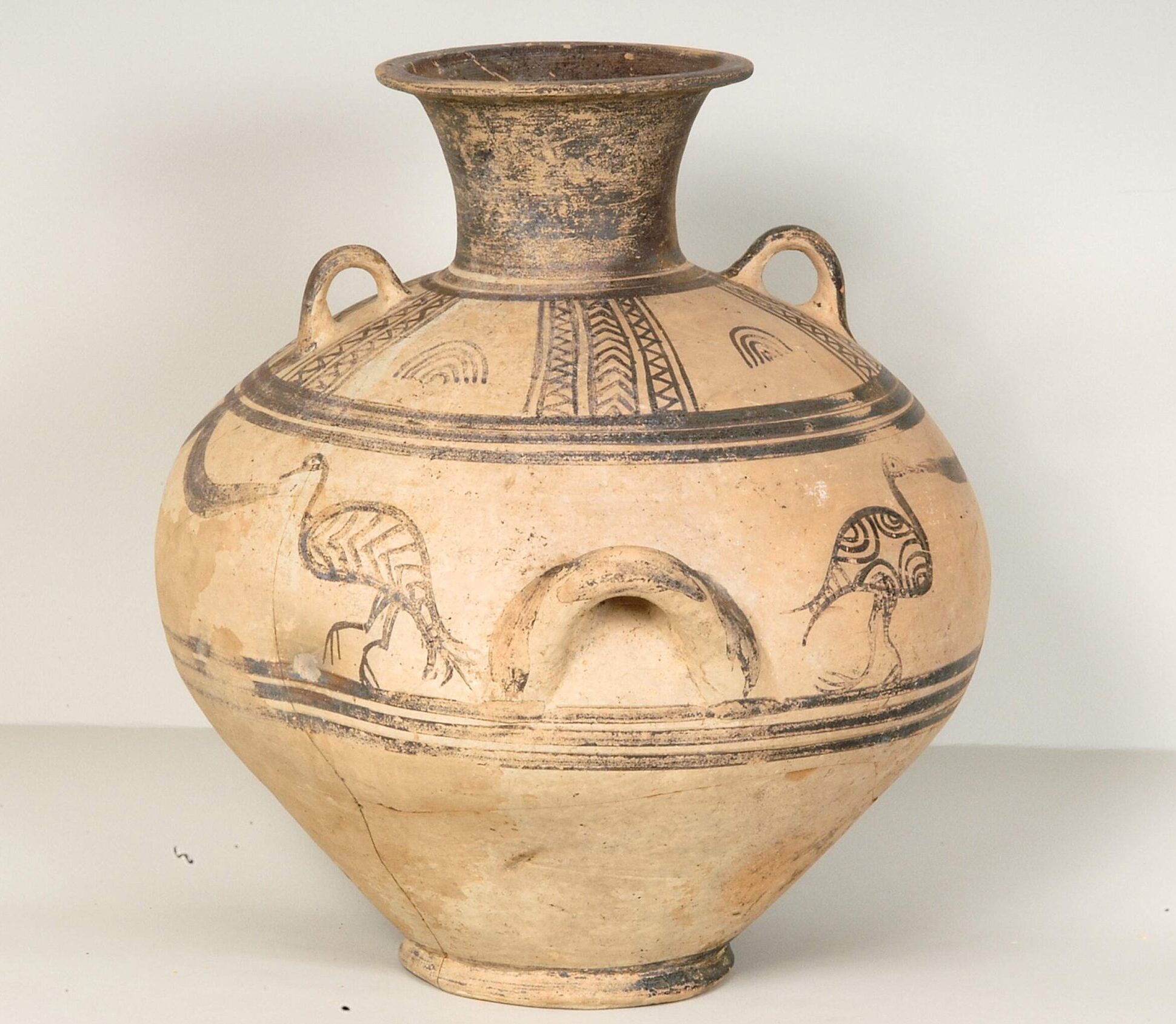
Clay bird-shaped vessel (Π04444), intact, with an askos-shaped body, a bird’s neck, tail and head. It stands on three legs, two at the front and one at the back. Its mouth is cylindrical. A tall spout with a broad rim and strap handle on the back, near the neck, served as the filling opening. The rims of both openings are fully painted; concentric semicircular arcs decorate both sides, and the outlines of the eyes are painted. A characteristic vessel shape of Elis and Achaia, associated with the cultural background of the “Western Koine”. From Palioboukouvinа, Agia Triada. Mycenaean period, Late Helladic III C (12th century BC).
Clay pyxis with lid (Π07622), intact and reassembled. It has a low cylindrical body and a flat base. The two-part lid has a cylindrical section fitting over the lower part and a domed upper section with a handle at the top. Thick dots decorate the back of the handle. The shoulder bears concentric circles, internally decorated lozenges, zigzag lines and bands. The body is decorated with bands, parallel diagonal lines and chevrons. It indicates connections with the Argolid. From Trypes, Kladeos, in the wider area of Olympia. Mycenaean period, Late Helladic III C (12th century BC).
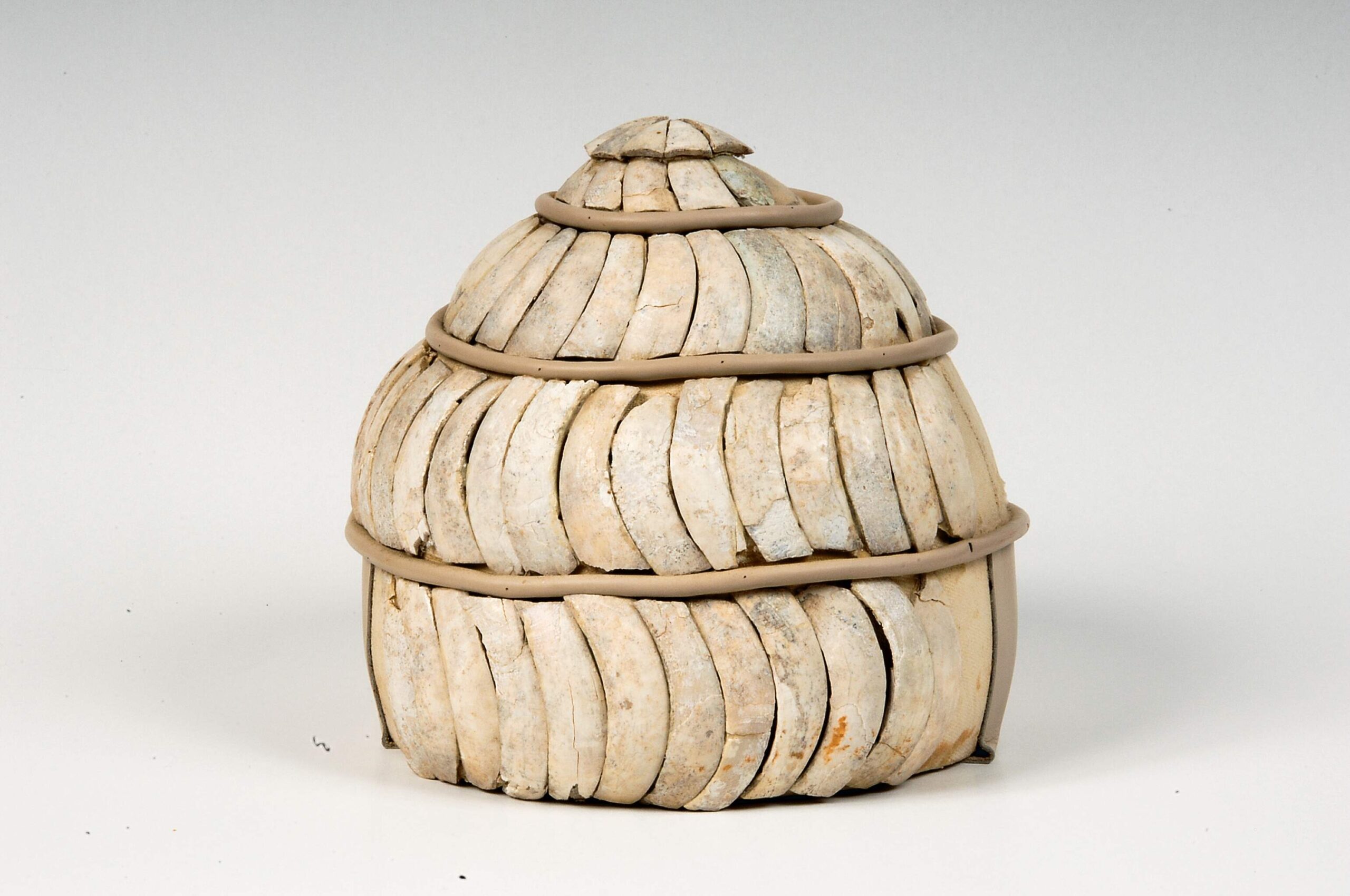
Intact clay Psi-type figurine (Π08231), with a round or elliptical upper body supported on a cylindrical stem. It wears a tall polos and has painted and moulded decoration. These small figurines have been interpreted as deities, divine nurses associated with graves, often those of young children, simple offerings in sanctuaries, or toys. Their meaning has been repeatedly discussed in research. Grave offering from the cemetery of Kladeos. Mycenaean period, Late Helladic III (14th–12th century BC).

Olympia became an important centre during the Early Helladic period. Vessels in the display cases reveal dietary practices and contacts with other prehistoric cultures of the Aegean, Asia Minor and the Balkans.

During the Mycenaean period, the Alfeios and its tributaries formed the focus of settlement in Elis, with Olympia occupying a prominent place.


