Visit-olympia : Οργανώστε ένα μοναδικό ταξίδι στα μνημεία και αξιοθέατα της Ηλείας και δημιουργήστε τη δική σας επική εμπειρία. Kάντε κλικ εδώ
Visit-olympia : Οργανώστε ένα μοναδικό ταξίδι στα μνημεία και αξιοθέατα της Ηλείας και δημιουργήστε τη δική σας επική εμπειρία. Kάντε κλικ εδώ

Pyrgos Archaeological Museum
Explore objects from the prehistoric collections of the Archaeological Museum of Pyrgos through 25 photographs. Select an image to view its description.
Open each description to learn more. Select a photograph to view the image at full size in a new tab.

01 / 25
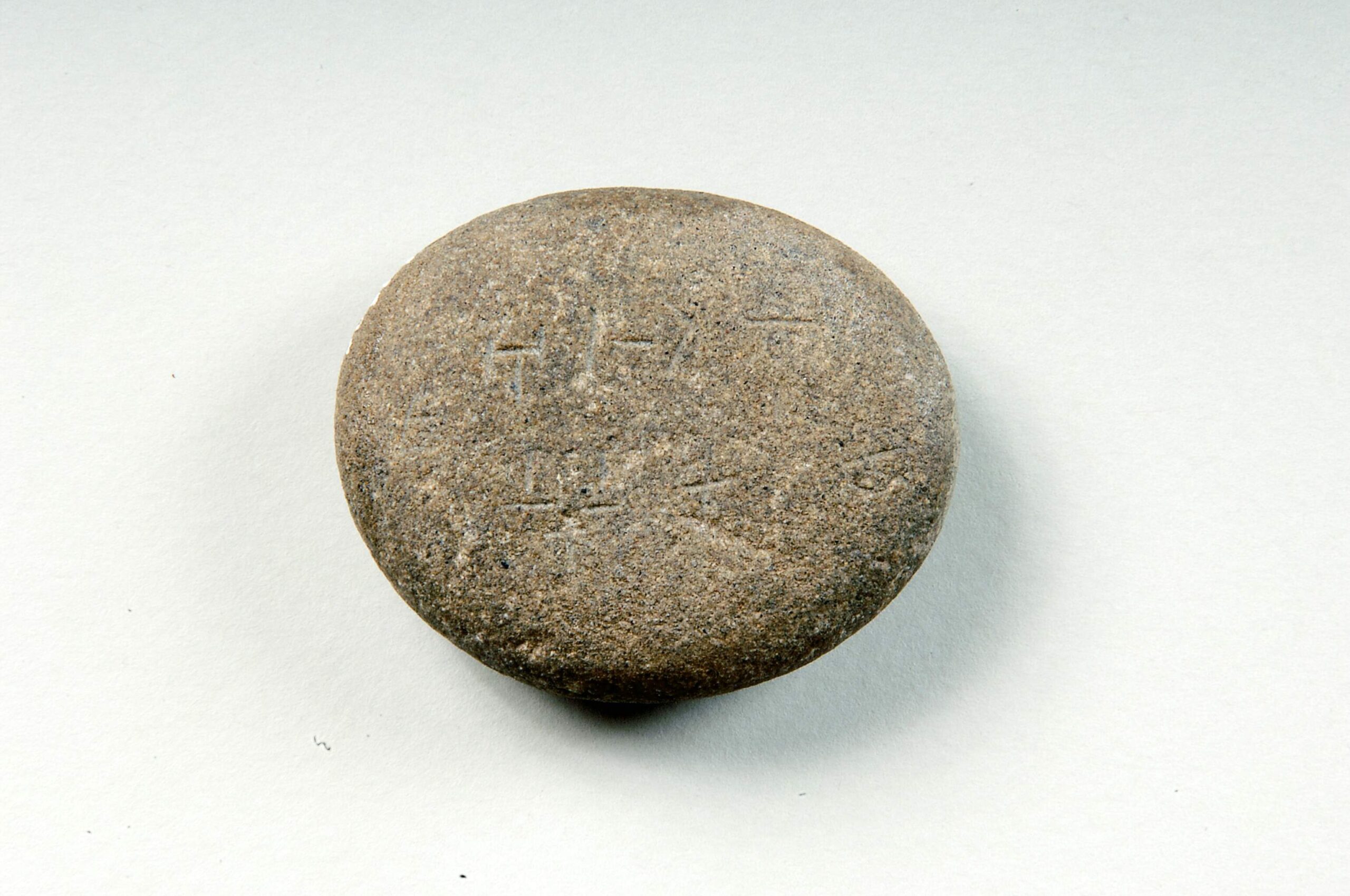
Incised river pebble (Λ01125), from the destruction layer of a Middle Helladic house, dated in the museum account to about 1650 BC. One face bears eight incised syllabic signs: five occur in both Linear A and Linear B, while three occur only in Linear B. The reading presented by the museum suggests an occupation, possibly a metalworker, and a personal name corresponding to the Greek name Charops. The other face bears a double axe flanked by two undeciphered signs, possibly associated with a ritual act. The museum account relates this interpretation to the development of Linear B on the Greek mainland.

02 / 25
Complete krater with painted figurative decoration (Π13850), used as a grave marker. Each side depicts two chariots with their drivers. The scene recalls the funeral games held for Patroclus, the friend of Achilles, in Homer’s account. The imagery is associated with Mycenaean chariot racing and the burial and commemoration of warriors. This outstanding example of Mycenaean vase painting was made in an Elean workshop. From the Mycenaean cemetery at Mageiras, at Kioupia near Ancient Olympia. 12th–11th centuries BC.

03 / 25
Gold ring depicting a winged sphinx seated on its hind legs and facing left. The sphinx wears a crown and necklace, with its wings spread and tail raised. Grave offering from Mageiras, Tomb 5. Mycenaean period, Late Helladic III (14th–12th centuries BC).

04 / 25
Bird-shaped clay vessel (Π8918), with a bag-shaped body, neck and bird’s tail, standing on a ring base. It has a cylindrical opening, an outward-curving rim and a strap handle on the back near the neck. The spout and base are fully painted; transverse lines decorate the handle, and concentric semicircles and panels of semicircles decorate the body. Grave offering from Kladeos, Trypes. Mycenaean period, Late Helladic IIIC (12th century BC).
05 / 25
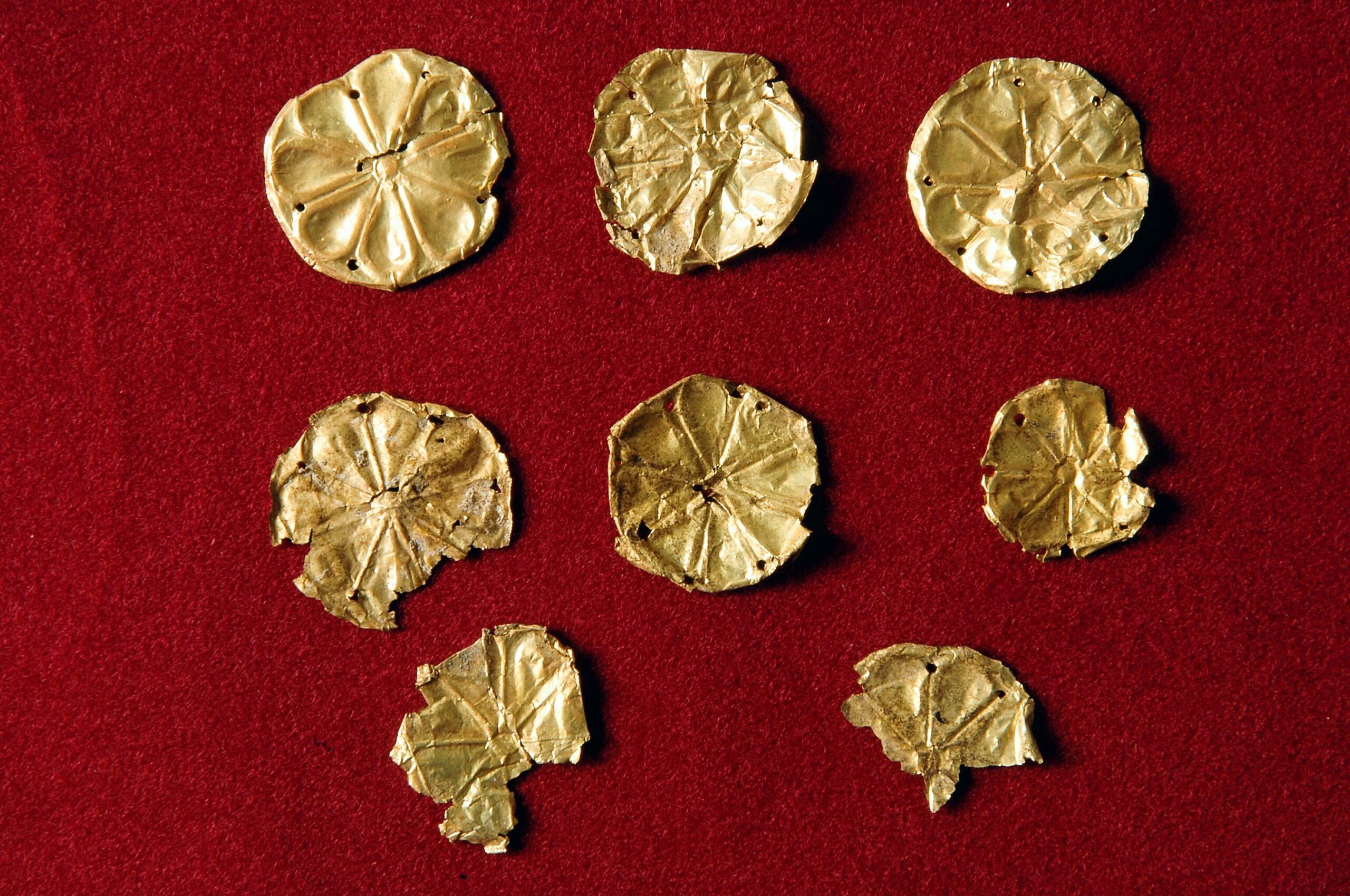
Gold rosette appliqués made from thin sheets (Δ965). Their state of preservation varies. Intended as ornaments, they were probably sewn onto luxurious garments or the shrouds of the dead, indicating wealth and high social status. Grave offerings from Agia Triada, Palioboukouvina. Mycenaean period, Late Helladic III (14th–12th centuries BC).
06 / 25
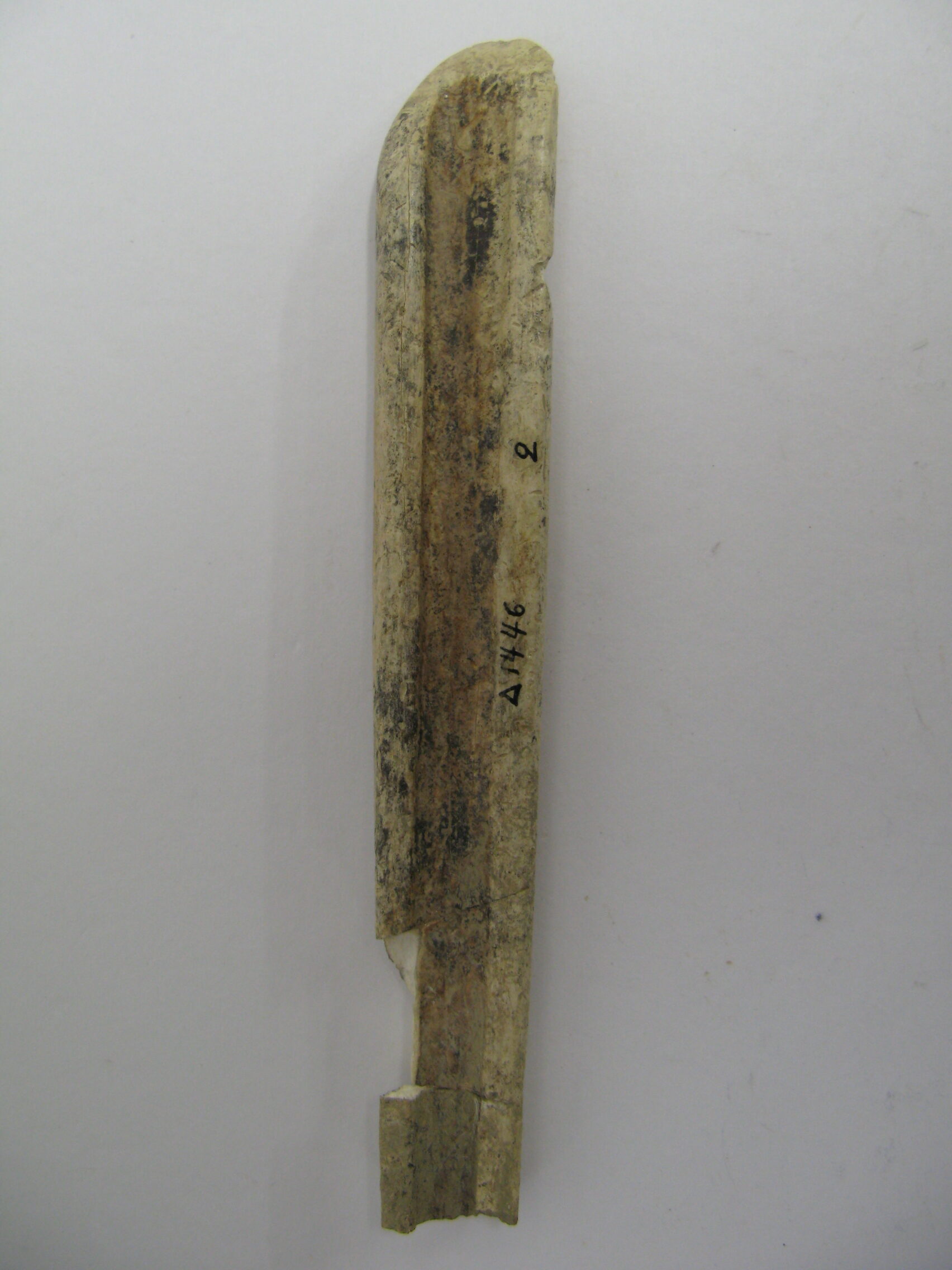
Bone spatula (Δ1446), made from a split shaft of a long bone, apparently the metapodial of a bovine or deer. It may have served as a potter’s smoothing or burnishing tool. From Lepreo, Agios Dimitrios. Final Neolithic (4500–3200 BC).

07 / 25
Mousterian flint point used for hunting by Neanderthals. Although no human bones have been identified in Elis in the museum account, their presence is attested by artefacts and tools. From the area of Kastro Kyllinis. Middle Palaeolithic (100,000–35,000 BC).

08 / 25
Polished stone axe or adze (Δ659), described as made of hard green stone (trachyte). The complete polished implement was used for fine woodworking. From Goumero, Kastro. Neolithic (6800–3200 BC).

09 / 25
Gold necklace (Δ964), comprising sixteen beads, each decorated with a heart-shaped double-nautilus motif. Grave offering from Agia Triada, Palioboukouvina. Mycenaean period, Late Helladic III (14th–12th centuries BC).

10 / 25
Stone mould for jewellery (Δ767), complete and slightly weathered, with an approximately rectangular shape. A shallow oval recess at the centre of the front face contains zigzag decoration; two small holes lie at diagonally opposite corners. Used to make a ring bezel. As a grave offering, it may indicate the occupation of the deceased as a goldsmith.

11 / 25
Horn-shaped clay vessel (Π8032), complete with minor damage. Its almost cylindrical body has a funnel-shaped rim, an inclined neck, a flat base and two pierced projections on the inner side. The rim and neck are fully painted. Bands of dots, interlace, zigzags, chevrons and pendant semicircles with central dots decorate the body. An imitation of a Cypriot vessel type. From Kladeos, Trypes. Mycenaean period, Late Helladic IIIC (12th century BC).

12 / 25
Composite clay vessel with glass-paste decoration (Π4572), an important Mycenaean grave offering. Drops of blue glass paste decorate the upper surface of the three-part handle and the discs joining the elements of the vessel. It also bears painted decoration. Its precise function has not been established. From Palioboukouvina, Agia Triada. Mycenaean period, Late Helladic (second half of the 16th–12th centuries BC).

13 / 25
Skull with a glass-paste diadem (Δ1425), found in a chamber tomb at Karavas, Kafkania, near Ancient Olympia. It belonged to a young woman aged about 21. The diadem comprises three rows of relief glass plaques retaining their striking blue colour. A similar skull with a surviving diadem was found in the Stravokefalos–Kladeos cemetery. Such finds provide evidence concerning age, sex, social status and, potentially, health and causes of death. Late Helladic III (14th–12th centuries BC).
14 / 25
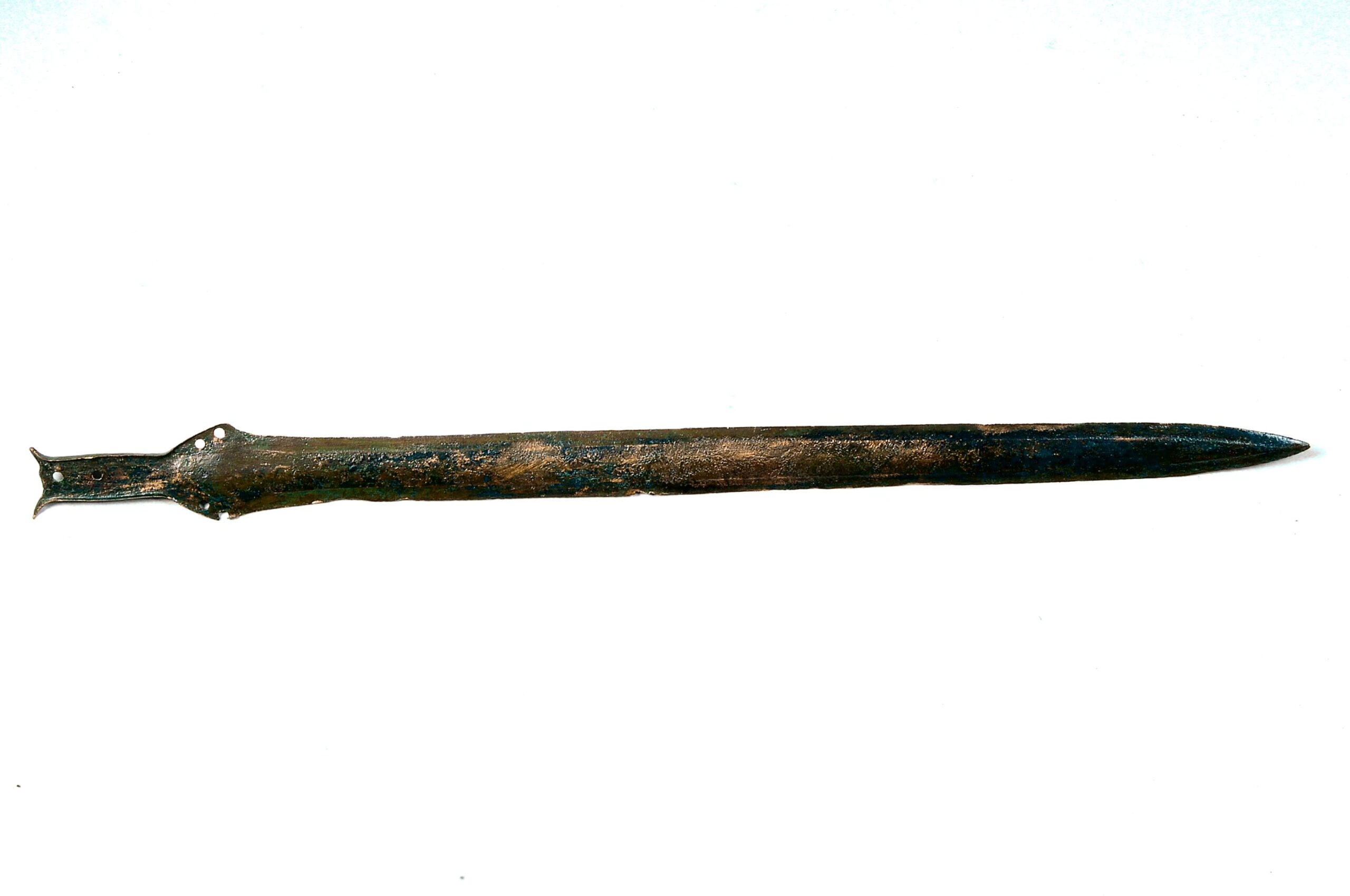
Bronze sword of Naue II type, preserved complete, rejoined and in good condition. It has a long blade, a swallowtail-shaped end to the grip and holes along the grip’s edges. Associated with a person of high social status, it belongs to the group known as European Naue II swords and was used for both cutting and thrusting. This type appears in Greece around 1200 BC.

15 / 25
Boar’s-tusk helmet (Δ126), a grave offering from the Mycenaean cemetery at Trypes, Kladeos. Reconstructed from 74 tusks, most complete, arranged in alternating rows. Each tusk has a horizontal perforation. Such helmets were used by the warrior elite. The reconstruction follows depictions on Mycenaean ivory plaques and clay vessels. Mycenaean period, Late Helladic III (14th–12th centuries BC).

16 / 25
Keftiu-type (Vapheio) clay cup (Π00075), rejoined from many fragments and restored. A raised ring divides the body into a cylindrical lower section and an upper section that opens outwards. It has a vertical strap handle and dense parallel vertical wavy lines. A characteristic drinking vessel of early Mycenaean pottery. From Kato Samiko, Kleidi. Late Helladic I (second half of the 16th century BC).
17 / 25
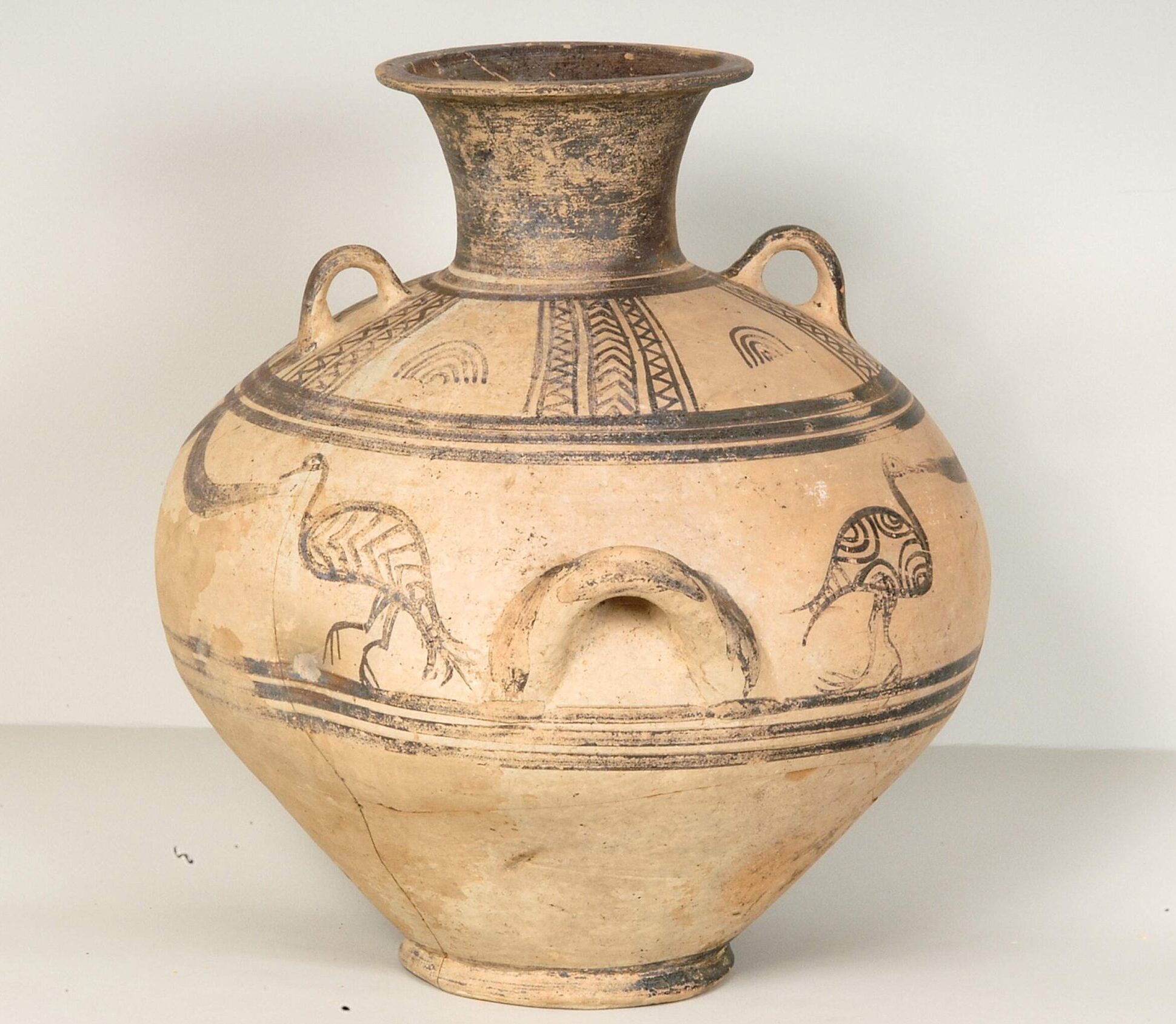
Four-handled clay amphora (Π07617), complete and rejoined. It has a projecting flat rim, a tall concave-sided neck, an ovoid body and a band-shaped base. Two horizontal handles lie at mid-body and two vertical strap handles on the shoulder. The rim, neck, strap handles and base are fully painted. Shoulder panels contain chevrons, zigzags and dotted or plain semicircles; brackets and bands appear beneath the strap handles. Four birds, decorated with chevrons and concentric semicircles, occupy the middle of the body. Grave offering from the Mycenaean cemetery at Trypes, Kladeos, near Olympia. Late Helladic IIIC (1200–1050 BC).

18 / 25
Cylindrical tripod alabastron with lid (Π08034), complete and excellently preserved. Two pairs of horizontal handles and two elongated pierced projections are attached at the shoulder. Three strap-shaped feet support the cylindrical body. Painted decoration includes opposed groups of scales on the shoulder, dashes on the handles, zigzags on the feet, and panels of zigzags, scales and lozenges enclosed by dotted circles on the body. The lid has a perforation at the top, concentric circles and bands, with a fully painted side. Grave offering from Trypes, Kladeos, near Olympia. Late Helladic IIIC (1200–1050 BC).
19 / 25
Another view of the incised river pebble from Kafkania (Λ01125).

20 / 25
Large clay rhyton (Π00070), rejoined and restored. Its pointed conical body has a wide mouth, a slightly concave neck and a raised strap handle. Parallel painted bands cover its full height. A ritual vessel deposited as a grave offering. From the burial mound at Kleidi, Kato Samiko. Mycenaean period, Late Helladic IIIA2 (second half of the 14th century BC).

21 / 25
Small three-handled clay storage jar (Π00092), complete. It has a pear-shaped body widening at the shoulder, a tall cylindrical neck, a broad horizontal rim and three similar horizontal shoulder handles. Painted ivy-leaf decoration shows Messenian and possibly Minoan influence. From Kato Samiko, Rasa. Mycenaean period, Late Helladic I (second half of the 16th century BC).

22 / 25
Complete Psi-type clay figurine (Π08231), with a rounded or elliptical upper body on a cylindrical stem. It wears a tall polos headdress and has painted and modelled decoration. The meaning of these small figurines remains debated: interpretations include deities, divine nurses in children’s graves, sanctuary offerings and toys. Grave offering from the cemetery of Kladeos. Mycenaean period, Late Helladic III (14th–12th centuries BC).

23 / 25
Bone stylus (Δ00512), long and narrow, with a flattened body tapering to a point. Small dotted circles decorate both faces. A rare grave offering from the Mycenaean cemetery at Palioboukouvina, Agia Triada, Elis, interpreted as an indication that the deceased was a scribe. Late Helladic III (14th–12th centuries BC).

24 / 25
Clay pyxis with lid (Π07622), complete and rejoined. The low cylindrical body has a flat base. The two-part lid has a cylindrical lower section, a domed top and a handle at its apex. Painted decoration includes dots on the handle, concentric circles, decorated lozenges, zigzags, bands, oblique parallel lines and chevrons. It reflects connections with the Argolid. From Trypes, Kladeos, in the wider Olympia area. Mycenaean period, Late Helladic IIIC (12th century BC).

25 / 25
Bird-shaped clay vessel (Π04444), complete, with a bag-shaped body, a bird’s neck, tail and head, and three feet. A cylindrical opening and a high, broad-rimmed spout beside the strap handle form its outlets and filling opening. The rims are fully painted; concentric semicircular arcs decorate both sides and painted outlines mark the eyes. A characteristic vessel form of Elis and Achaia, associated with the cultural horizon known as the Western Koine. From Agia Triada, Palioboukouvina. Mycenaean period, Late Helladic IIIC (12th century BC).


