Visit-olympia : Οργανώστε ένα μοναδικό ταξίδι στα μνημεία και αξιοθέατα της Ηλείας και δημιουργήστε τη δική σας επική εμπειρία. Kάντε κλικ εδώ
Visit-olympia : Οργανώστε ένα μοναδικό ταξίδι στα μνημεία και αξιοθέατα της Ηλείας και δημιουργήστε τη δική σας επική εμπειρία. Kάντε κλικ εδώ

Pyrgos Archaeological Museum
Archaeological evidence reveals prehistoric Elis as a lively, creative and productive part of a continually evolving culture. Benefiting from a favourable climate, fertile land and a strategic location, its inhabitants developed a flourishing culture.
Imported objects document the commercial, economic and artistic exchanges of Elis with neighbouring regions, including the northwestern Peloponnese, Arcadia, the Ionian Islands, the Argolid and Messenia, and with more distant parts of the Aegean, such as Crete and Cyprus.
Ancient myths concerning Aethlios, the Idaean Herakles and the earliest priests of Olympia, Aitolos and Pelops, among others, connect Elis with Thessaly, Aetolia, Crete and Asia Minor.
The natural harbours of Kyllini and Pheia (the ancient name of Agios Andreas near Katakolo), on the northwestern coast of Elis, were important gateways for goods and trading stations. Among the materials imported was obsidian from Melos, from the Mesolithic period onwards.
Primarily through maritime trade, the inhabitants of Elis acquired copper alloys and tin. Gold, silver, lead and semi-precious stones, including carnelian and rock crystal, also circulated in exchange networks.
Imported pottery, obsidian, metal objects and jewellery indicate small-scale exchanges between Elis, the Aegean and Crete. What Elis supplied in return is unknown, although food, timber, hides and locally made pottery are possible candidates.
During the Mycenaean period, exchanges of goods and ideas extended further across the Aegean, to Cyprus, northern Europe and the Near East.
The archaeological remains reveal Achaean influence north of the Alpheios and Messenian influence to its south.
The strategic position of Elis facilitated the circulation of goods and ideas, contributing to a “Western Koine”, a distinctive artistic and cultural language with shared characteristics.
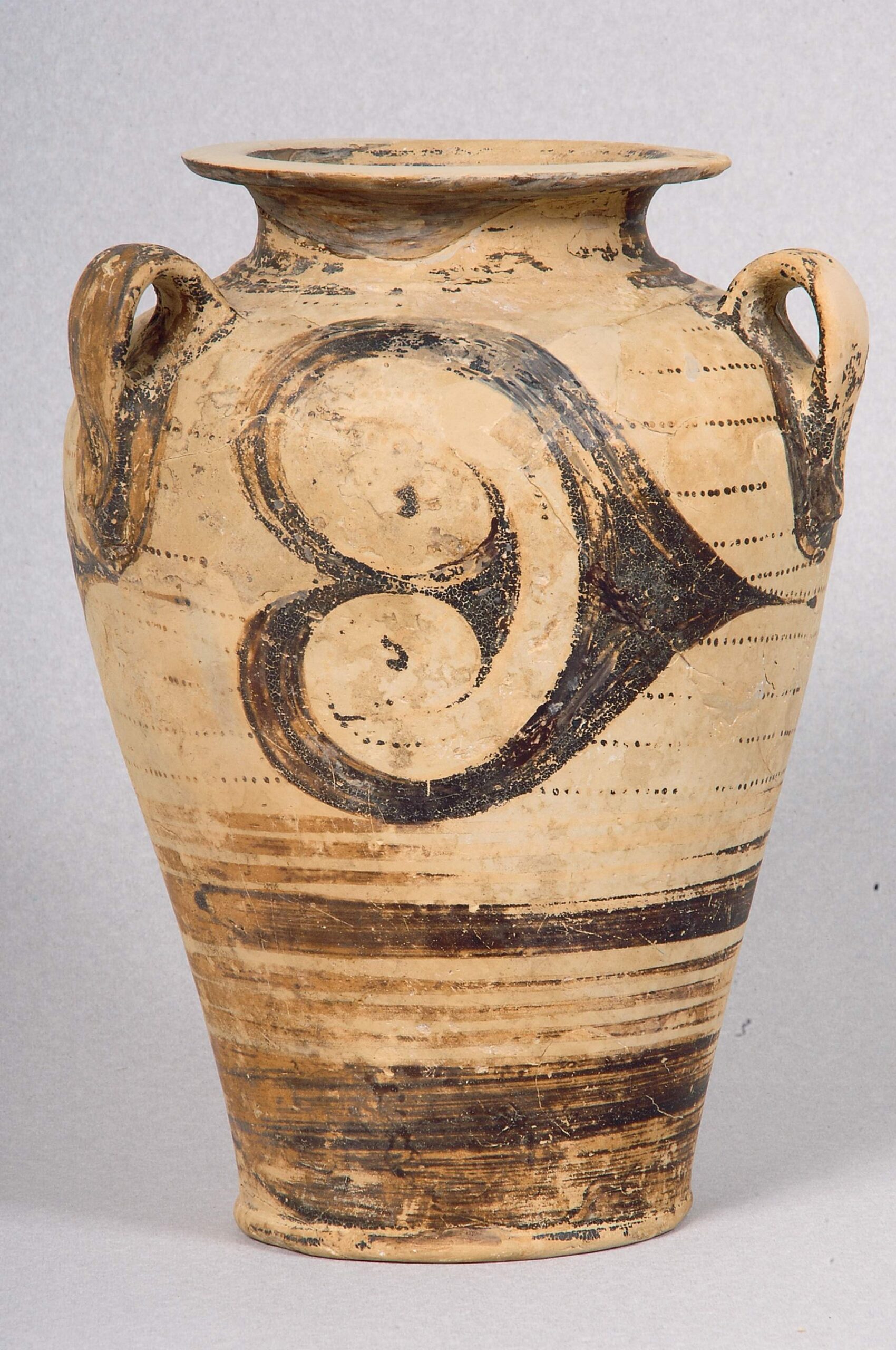
Complete small three-handled clay storage jar (Π00092), with a pear-shaped body widening at the shoulders, a tall cylindrical neck, a broad horizontal rim and three similar horizontal shoulder handles. Painted ivy-leaf decoration shows Messenian and probably Minoan influences. From Rasa, Kato Samiko. Late Helladic I, second half of the 16th century BC.

Complete horn-shaped clay vessel (Π8032), with minor damage. Its body is nearly cylindrical, with a funnel-shaped rim, inclined neck, flat base and two perforated projections on the inner side. Rim and neck are fully painted. Banded decoration includes dots, plait motifs, zigzags, chevrons and hanging semicircles with central dots. An imitation of a Cypriot vessel. From Trypes, Kladeos. Late Helladic IIIC, 12th century BC.

Clay pyxis with lid (Π07622), complete and reassembled. It has a low cylindrical body and flat base. The lid covers the lower vessel and rises to a domed top with a handle. Decoration includes dots, concentric circles, decorated lozenges, zigzags, bands, oblique parallel lines and chevrons. It indicates connections with the Argolid. From Trypes, Kladeos, near Olympia. Late Helladic IIIC, 12th century BC.
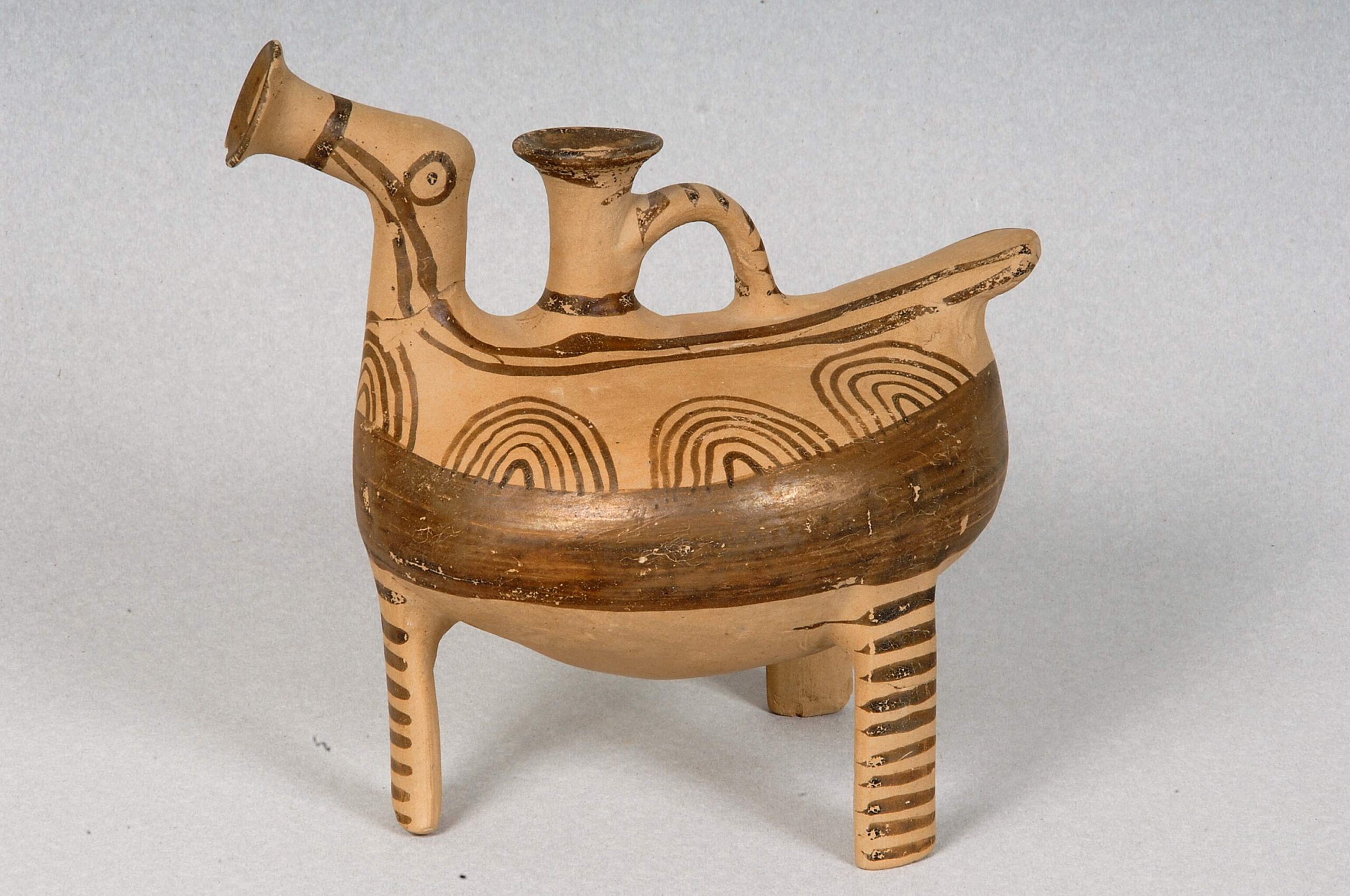
Complete bird-shaped clay vessel (Π04444), with an askos-like body, neck, tail and bird’s head, standing on three feet. A high spout near the neck, with broad rim and strap handle, served as the filling opening; the other mouth is cylindrical. Both rims are painted, with concentric semicircular arcs on either side and painted outlines around the eyes. A characteristic vessel of Elis and Achaea, associated with the “Western Koine”. From Palioboukouvina, Agia Triada. Late Helladic IIIC, 12th century BC.